U Visa Requirements, and Process for Crime Victims in 2026
Learn who may qualify for a U Visa, 2026 eligibility requirements, qualifying crimes, Form I-918, law enforcement certification, supporting evidence, and the U Visa application process.
Recent reviews from our clients on Google
Read all 884 reviews on Google“I am very satisfied with the staff who answer each of my calls and give me the confidence to move forward with my case. I know I’ve only just started and the wait is long, but I have the full support of attorney Elizabeth Rosario and her team, and that gives me a lot of confidence! Thank you, attorney Elizabeth.”
Ana
September 2026
“First, thanks to God and to lawyer Elizabeth. Today everything went very well with the biometrics. I am very grateful. When another place told me no, she said here we can, and here are the results. Greetings, and may she continue fighting for our people.”
Israel G.
September 2026
“First of all, I would like to thank Attorney Elizabeth’s entire team for their daily work and kindness. My husband and I are extremely happy with the service and how they handle their work. I highly recommend them to anyone. Don’t hesitate to contact Attorney Elizabeth if you are looking for an immigration lawyer. I recommend her 100%. Best regards and blessings.”
Sarahi S.
September 2026
Reviews are written by clients and published on Google. Each describes that person’s own experience; past results do not guarantee a similar outcome in your case.

U Visa Requirements, and Process for Crime Victims in 2026
Whether you are preparing to apply for a U Visa for the first time or helping a family member understand their options, this guide explains general eligibility requirements, qualifying criminal activity, Form I-918, law enforcement certification, and supporting evidence used in the application process under 2026 current immigration law.
This information is intended for educational purposes only and does not constitute legal advice.
What Is a U Visa?
U nonimmigrant status, commonly called a U Visa case, is a humanitarian immigration protection available to certain victims of qualifying criminal activity who meet specific requirements under federal immigration law.
Under the Trafficking and Violence Protection legislation, eligible applicants must generally demonstrate substantial physical or mental abuse and helpfulness to law enforcement.
Please consult a Licensed Immigration Attorney for guidance based on your particular case. At Elizabeth Rosario Law, our Licensed Attorneys help applicants understand their eligibility and the legal options that may be available in their individual circumstances.
U Visa Requirements: Who Can Qualify?
The general visa u eligibility requirements focus on proving both the crime and the applicant's cooperation with authorities. A successful case usually includes evidence showing that:
A qualifying criminal activity occurred.
The applicant suffered substantial physical or mental abuse.
The applicant was helpful, is being helpful, or is willing to help authorities.
The applicant qualifies under immigration law or is eligible for a waiver.
Every u visa petition should include strong supporting documents.
Form I-918, Petition for U Nonimmigrant Status
To be eligible to apply for a U Visa, the principal petitioner files Form I-918, Petition for U nonimmigrant status, with USCIS (Citizenship and Immigration Services). A complete filing usually includes:
Form I-918,
Supporting I-918 supplements,
Investigation or prosecution of the qualifying criminal activity.
Every case is unique. Providing organized and complete evidence can help USCIS understand the facts and reduce the likelihood of delays or requests for additional information.
Because every immigration case is different, please consult a Licensed Immigration Attorney for guidance based on your particular case. At Elizabeth Rosario Law, our licensed immigration attorneys assist eligible victims of domestic violence and other qualifying criminal activity in understanding their U Visa options.
What Qualifying Criminal Activity Can Support a U Visa?
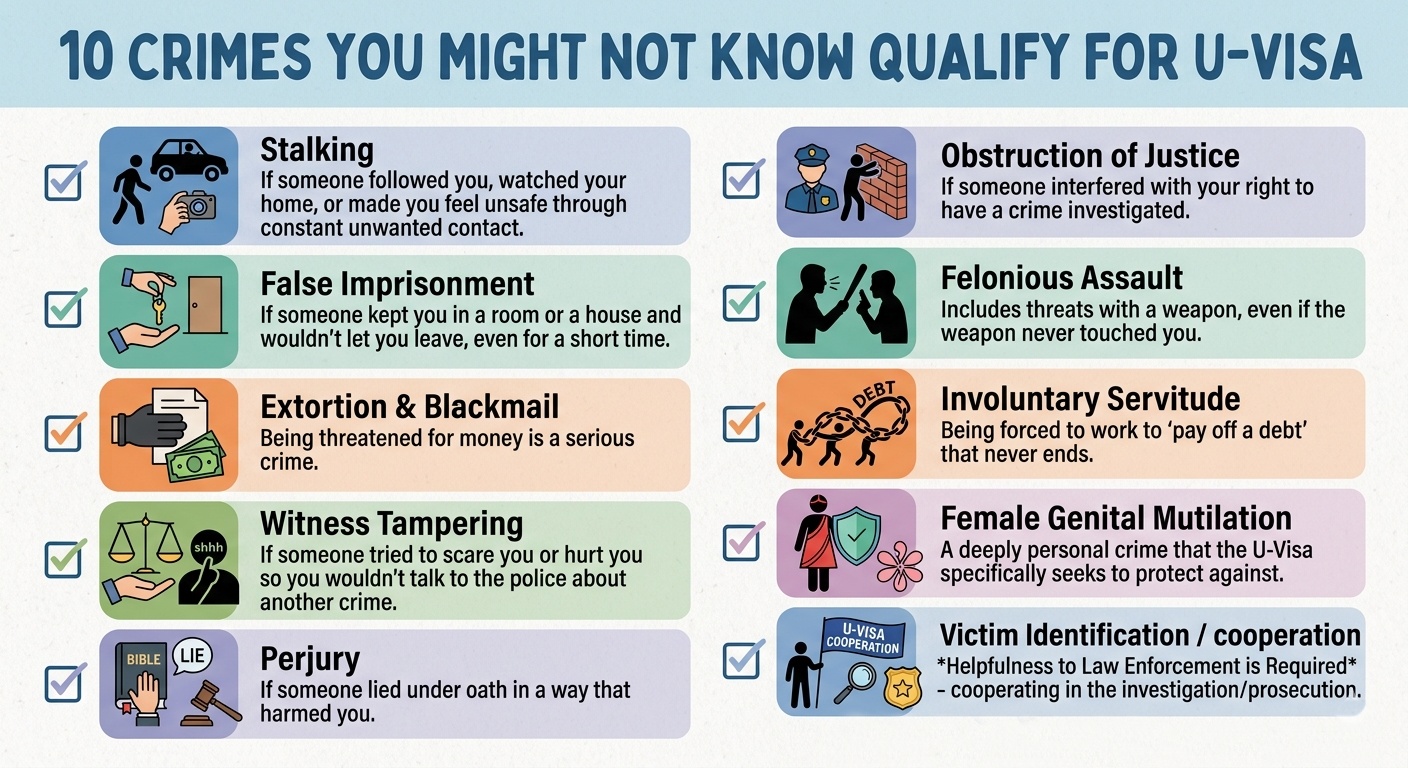
Federal immigration law identifies categories of qualifying criminal activity that may support a U Visa petition when the other legal requirements are satisfied. Common qualifying criminal activities include:
domestic violence,
sexual assault,
kidnapping,
trafficking,
felonious assault,
and extortion.
USCIS also considers emotional and psychological harm when deciding whether someone has suffered substantial physical or emotional abuse.
If your case involves labor trafficking instead of another qualifying crime, our T Visa Requirements & Eligibility Guide 2026 explains the protections available for trafficking survivors. Please be advised by a Licensed Immigration Attorney for your particular case.
Frequently Asked Questions
Can I apply if I entered the United States without inspection?
Entering the country without inspection does not automatically prevent someone from qualifying. USCIS (Citizenship and Immigration Services) reviews every case individually, and some applicants may qualify for a waiver.
Do I need to testify in court?
Every criminal case is different, some applicants satisfy the cooperation requirement without appearing in court.
Can I receive a work permit?
Some applicants may become eligible to request employment authorization after receiving a favorable bona fide determination or after approval, depending on the stage of their case and current USCIS policies.
Do You Need a Police Report to Apply?
This helpfulness requirement is documented through Form I-918 Supplement B, U Nonimmigrant Status Certification, completed by an authorized certifying official. The certification addresses the qualifying criminal activity and whether the petitioner has been helpful, or is likely to be helpful in its detection, investigation or prosecution.
What Is a Bona Fide Determination?
Many applicants have questions about bona fide status because of the current processing backlog.
USCIS may conduct an initial Bona Fide Determination (BFD) review of certain pending U Visa petitions. A favorable BFD does not approve the underlying petition or grant U nonimmigrant status, but qualifying petitioners may receive deferred action and employment authorization while USCIS continues adjudicating the case.
How long does the process take?
Because of annual limits and high demand, u visa processing times can extend for several years. Processing varies based on the facts of each case, USCIS workload, and federal immigration policies.
If you would like to learn more about what happens after filing, including wait times, work permits, deferred action, and benefits available while waiting for a decision, you can read our guide: U Visa Benefits in 2026: Processing Times & Bona Fide Status.

Can Qualifying Family Members Receive U Visa Benefits?
Certain qualifying family members of principal U Visa applicants may also be eligible for derivative U nonimmigrant status. Who may qualify generally depends on the principal applicant’s age when the principal U Visa petition is filed.
The relative eligible family members must meet the legal requirements established by USCIS; if the principal applicant is under 21:
A spouse.
Children.
Parents.
If the principal applicant is 21 or older, eligible family members may include:
A spouse.
Unmarried children under age 21.
Common U Visa Application Mistakes to Avoid
Preparing a complete U Visa application requires careful attention to the forms, certification, and supporting evidence. Missing or inconsistent information may result in additional USCIS review or a Request for Evidence (RFE).
Before filing, applicants should carefully review:
The law enforcement certification
Any USCIS notice or Request for Evidence (RFE)
U Visa cases can involve complex eligibility, evidence, and immigration law requirements. Please consult a Licensed Immigration Attorney for guidance based on your particular case. At Elizabeth Rosario Law, our Licensed Attorneys help applicants understand their eligibility, evaluate supporting evidence, and explore the legal options that may be available under immigration law.
Can a U Visa Lead to Permanent Residency?
U nonimmigrant status may eventually provide a path to permanent residency for eligible applicants. After meeting the applicable requirements, including generally at least three years of continuous physical presence in the United States in U nonimmigrant status, an eligible person may apply to become a lawful permanent resident by filing Form I-485. Additional eligibility requirements apply.
Speak With a Licensed Immigration Attorney
U Visa cases often involve complex immigration law issues, detailed evidence requirements, and extensive USCIS review. At Elizabeth Rosario Law, our Licensed Immigration Attorneys help trafficking victims understand their legal options, prepare supporting documentation, and navigate the U Visa applications process; we are ready to listen.
📞 Schedule Your FREE Evaluation Today to discuss your specify immigration situation and receive guidance related to your case.
Fully Bilingual Counsel: We eliminate communication barriers by managing your entire file, evidentiary records, and interview preparation sessions in your native language.
Call Our National Consult Line: (855) 627-2292
We proudly serve clients across all 50 states from our primary offices in Wyoming, Michigan, and Charlotte, North Carolina. U Visa
Disclaimer: This content is for general informational purposes only and does not constitute legal advice. Immigration laws change frequently and the information here may not reflect the most current legal developments. Consult an attorney for advice on your specific situation.

Elizabeth Rosario, Esq.
Immigration Attorney with over 14 years of experience helping families navigate complex immigration matters.