U Visa Requirements in 2026: Who Qualifies and How to Apply
Learn who qualifies for a U Visa in 2026, what crimes qualify, how Form I-918B works, police cooperation requirements, and common U Visa mistakes that may cause denials.
If you were the victim of a qualifying crime in the United States, the U Visa may provide temporary legal status, work authorization, and a potential pathway to lawful permanent residence. This immigration benefit was created to help crime victims who have suffered substantial harm and have assisted, or are willing to assist, law enforcement in the investigation or prosecution of criminal activity.
U Visa Requirements in 2026: Who Qualifies and How to Apply
What Is a U Visa?
The U Visa is a humanitarian immigration benefit created for victims of certain crimes who suffered substantial physical and mental harm and helped law enforcement investigate or prosecute the crime.
A U Visa may help eligible immigrants:
receive lawful status in the United States,
receive protection from deportation,
and eventually apply for lawful permanent residence.
To qualify for a U Visa in 2026, applicants generally must:
be a victim of a qualifying crime,
suffer substantial physical and mental abuse,
cooperate with police or prosecutors,
obtain a signed U Visa certification (Form I-918B), and show admissibility or qualify for a waiver.
Who Qualifies for a U Visa?
A person may qualify for a U Visa if they were the victim of a qualifying criminal activity, suffered substantial harm, and cooperated with law enforcement during the investigation or prosecution.
Basic U Visa Requirements in 2026
To qualify for a U Visa, USCIS generally requires applicants to prove:
they were a victim of a qualifying crime,
they suffered substantial physical and mental abuse,
they cooperated with law enforcement,
and they are admissible or eligible for a waiver.
Many immigrants incorrectly believe they cannot apply because they:
overstayed a visa,
worked without authorization,
or are currently in removal proceedings.
However, the U Visa was specifically created to protect victims of certain crimes that apply to the U Visa protection regardless of immigrant status. Please be advised by a Licensed Immigration Attorney for your particular case.
What Crimes Qualify for a U Visa?
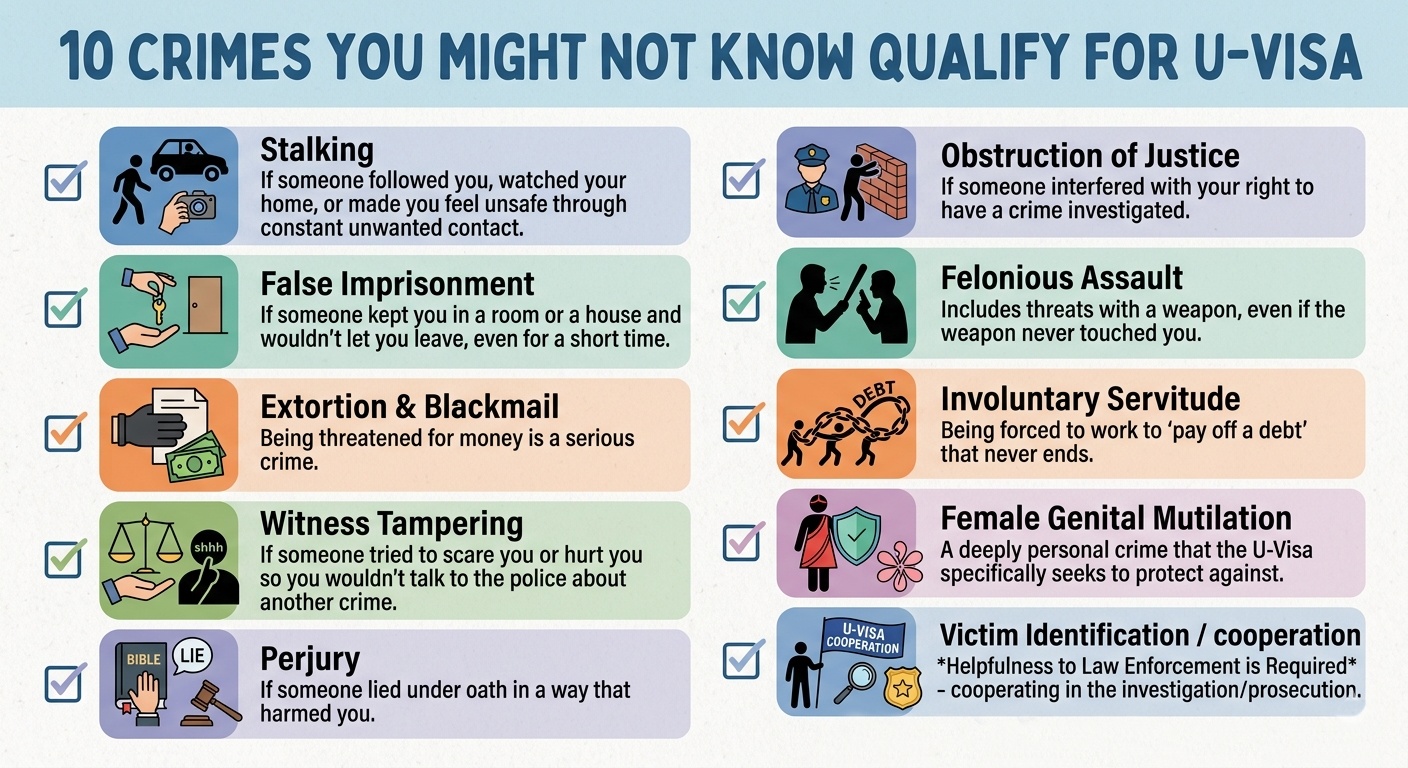
USCIS recognizes more than 28 qualifying criminal activities for U Visa eligibility, including domestic violence, sexual assault, stalking, trafficking, extortion, fraud, kidnapping, and felonious assault.
Common U Visa Crimes
domestic violence,
sexual assault,
kidnapping,
trafficking,
felonious assault,
obstruction of justice,
and extortion.
Many people searching “what crimes qualify U Visa” are surprised to learn that emotional abuse, threats, coercion, and financial exploitation may also qualify. USCIS focuses on whether:
a qualifying criminal activity occurred,
the victim suffered substantial harm,
and the victim cooperated with authorities.
Can Fraud or Financial Crimes Qualify for a U Visa?
Yes. Certain fraud, extortion, blackmail, and financial crimes against immigrants may qualify for a U Visa when victims suffered substantial physical and mental harm and cooperated with law enforcement.
U Visa Fraud and U Visa Extortion Cases
Many immigrants say: “They did not hit me. They only took my money.” However, financial crimes can still create serious emotional trauma and psychological harm. Examples of qualifying situations may include:
labor trafficking,
passport confiscation,
and extortion threats targeting undocumented immigrants.
In many U Visa fraud or U Visa extortion cases, criminals threaten to:
report victims to immigration,
contact ICE,
harm family members,
USCIS may recognize these situations as qualifying criminal activity when victims experienced substantial harm.
Do You Need a Police Report for a U Visa?
Most U Visa application cases require cooperation with police or prosecutors, and applicants generally need evidence of an official investigation connected to the crime.
Reporting Crime Without Deportation
One of the most common fears immigrants have is: “If I report the crime, will I be deported?”. Form I-918B was specifically created to encourage victims to report crime without deportation fears while applying for protection. Applicants cooperate with police U Visa investigations, generally focused on:
investigating the crime,
protecting the victim,
and prosecuting offenders.
Victims may still qualify even if:
the suspect was never arrested,
the case never went to trial,
or prosecutors dismissed the charges.
Helpful evidence may include:
police reports,
restraining orders,
witness statements records,
What Is the U Visa Certification (Form I-918B)?
Form I-918B Supplement B, is the document signed by law enforcement confirming that a victim cooperated in the investigation or prosecution of a qualifying crime. For a complete explanation of evidence requirements, U Visa Benefits, Work Permit and Wait Times, see our guide: U Visa Benefits in 2026: Work Permit & Wait Times.
Why the Supplement B U Visa Matters?
The Supplement B I-918B certification is one of the most important documents in the entire case, because the certification confirms:
a qualifying criminal activity occurred,
the victim had helpful information,
and the victim cooperated with law enforcement.
This is one of the most common areas where applicants make serious I-918B mistakes, form must generally be submitted within 6 months of signature. Please be advised by a Licensed Immigration Attorney for your particular case.
Who Can Sign the U Visa Certification?
Several agencies may sign a U Visa certification, including police departments, prosecutors, judges, and Child Protective Services (CPS).
Agencies That May Sign Form I-918B
Depending on the case, certifying agencies may include:
district attorneys,
criminal court judges,
and other investigative agencies.
Some victims are incorrectly told they do not qualify simply because one agency refused to sign; please be advised by a Licensed Immigration Attorney for your particular case.
Do You Need a Conviction to Qualify?
No. A criminal conviction is not always required for U Visa eligibility. However, some successful U Visa applicants receive approval even when:
the suspect was never arrested,
or prosecutors never filed a case.
USCIS mainly focuses on whether:
the crime was investigated,
the victim cooperated with law enforcement,
and the victim provided helpful information.
Can Children or Family Members Qualify?
The U Visa application, when approved, includes important protections for minors and families. When the victim is a child, parents or guardians may sometimes cooperate with law enforcement on the child’s behalf. Depending on the applicant’s age, qualifying family members may include:
U Visa Minors and Family Protection
spouses,
children,
parents,
or unmarried siblings under 18.
U Visa vs. VAWA: What Is the Difference?
The main difference between a U Visa application and VAWA is that the U Visa requires cooperation with law enforcement, while VAWA is based on abuse by a U.S. citizen or lawful permanent resident family member.
Difference Between U Visa and VAWA
A U Visa may be the stronger option when:
the offender is undocumented,
the offender is not a family member.
VAWA may be available when:
the abuser is a U.S. citizen,
the abuser is a Green Card holder,
and the victim prefers not to involve police.
Common U Visa Mistakes That Cause Denials
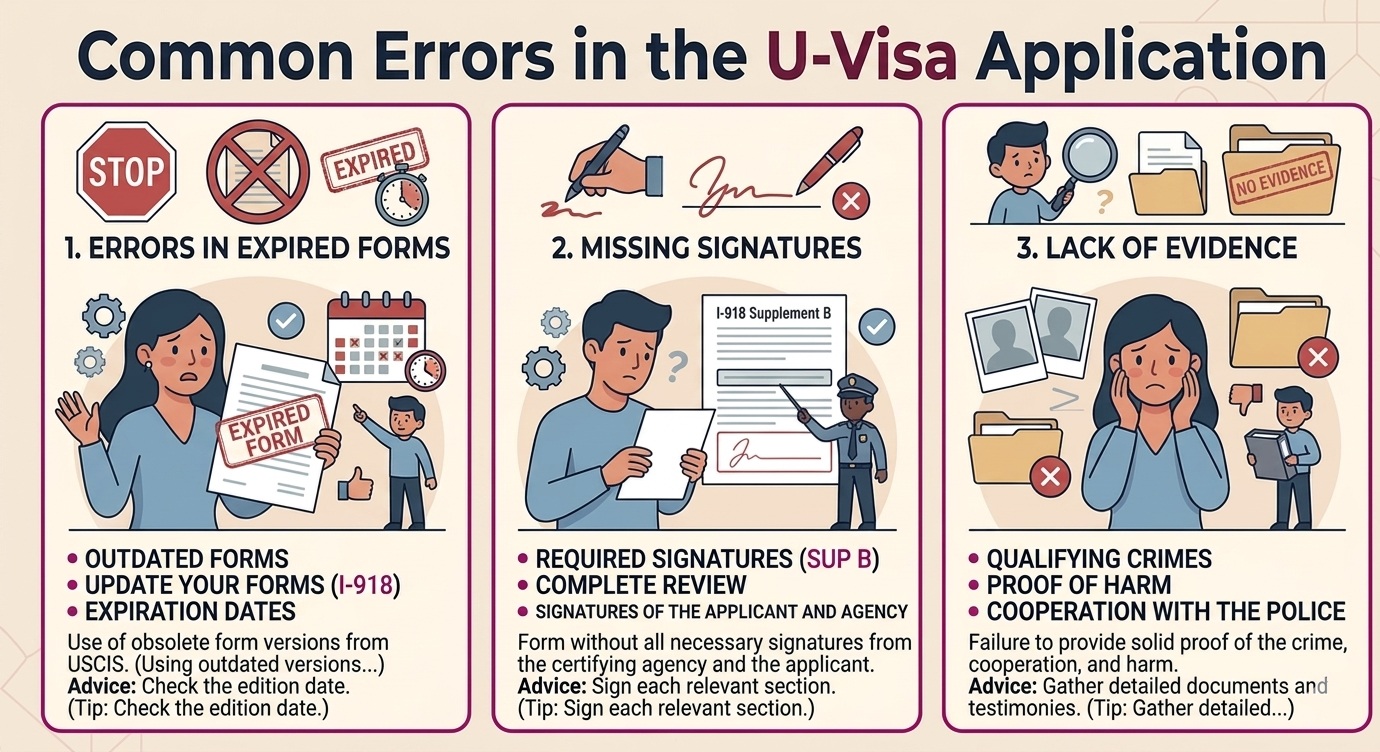
Many U Visa denials happen because of filing errors, expired certifications, weak evidence of substantial harm, or missing immigration waivers. Some of the most common U Visa errors include:
Common U Visa Errors and I-918 Mistakes
Missing the 6-Month Deadline
Once Form I-918B is signed, applicants generally have only 6 months to submit application it to USCIS.
Weak Evidence of Substantial Harm
USCIS requires evidence of substantial physical and mental abuse. A psychological evaluation U Visa report may help document emotional trauma and mental harm; helpful evidence also may include:
psychological evaluations,
Police reports of harm,
medical records.
Waiver Problems
Some applicants require Form I-192 waivers for immigration violations or inadmissibility issues.
Failure to Respond to RFEs
Requests for Evidence (RFEs) must be answered correctly and on time. Failure to respond may result in a U Visa denial.
Speak With a Licensed Immigration Attorney
U Visa cases often involve complex immigration law issues, detailed evidence requirements, and extensive USCIS review. At Elizabeth Rosario Law, our Licensed Immigration Attorneys help trafficking victims understand their legal options, prepare supporting documentation, and navigate the U Visa application process; we are ready to listen.
If you believe you may qualify for a U Visa, 📞 Schedule Your FREE Evaluation Today to discuss your situation and learn about the next steps available under current immigration law, because:
Fully Bilingual Counsel: We eliminate communication barriers by managing your entire file, evidentiary records, and interview preparation sessions in your native language.
Strategic Legal Shields: We go far beyond mechanically typing data onto a Form I-918B. We design personalized defense strategies specifically engineered to safeguard your authorized stay and help you avoid removal proceedings.
Call Our National Consult Line: (855) 627-2292
We proudly serve clients across all 50 states from our primary offices in Wyoming, Michigan, and Charlotte, North Carolina.
Disclaimer: Este contenido es solo para fines informativos generales y no constituye asesoramiento legal. Las leyes de inmigración cambian frecuentemente y la información aquí puede no reflejar los desarrollos legales más recientes. Consulte a un abogado para obtener asesoramiento sobre su situación específica.
Elizabeth Rosario, Esq.
Immigration Attorney with over 14 years of experience helping families navigate complex immigration matters.
Boletín Informativo
Suscríbase a nuestro boletín para recibir actualizaciones importantes sobre leyes migratorias y recursos para su caso.
Respetamos su privacidad. Puede cancelar su suscripción en cualquier momento.