Share this article:
T Visa: Requirements, Processing Times, and 2026 Guide
Immigration Law

T Visa: Requirements, Processing Times, and 2026 Guide

Elizabeth Rosario
April 8, 2026Updated: May 5, 2026
35 min read

If you are a survivor of human trafficking, the T Visa offers a path to safety, work authorization, and permanent residency in the United States. At Elizabeth Rosario Law, we help you navigate this process with compassion and legal expertise.

T Visa: Requirements, Processing Times, and 2026 Guide 

The T Visa is a special immigration status for victims of human trafficking. This law ensures that survivors receive protection instead of punishment. It allows you to stay in the United States legally if you help law enforcement investigate your traffickers. 

At Elizabeth Rosario Law (ERL), we know that moving from fear to safety is the hardest part of your journey. This guide shows you exactly how the T Visa protects you, your family, and your future starting today.  

What is a T Visa?  

The T Visa serves as a lifeline for survivors of human trafficking. Federal law protects you if you were forced into labor or commercial sex work through force, fraud, or coercion. 

The government created this status under the Victims of Trafficking and Violence Protection Act (TVPA). It allows you to live and work legally in the U.S. for up to four years and provides a direct path to a Green Card.  

5 Main Benefits of the T Visa 

Once USCIS approves your T nonimmigrant status, you gain immediate security through these benefits: 

  • Legal Protection: You gain safety from deportation and removal proceedings. 

  • Work Authorization: You receive an Employment Authorization Document (EAD) to work legally in any job. 

  • Family Reunification: You can include your spouse, children, and in some cases, your siblings or parents in your application. 

  • Federal Benefits: You get access to vital social services, including healthcare and housing assistance. 

How Do I Know if I Am a Victim of Trafficking? 

Many survivors do not recognize themselves as victims because traffickers often normalize the abuse. You might feel like you are just in a "bad job," but the reality is different. If you have ever asked yourself, “They took my passport and didn’t pay me—is that really trafficking?”—the answer is yes. Trafficking does not always involve physical chains; it involves control. Recognizing these signs is the first step toward your legal protection. 

Common Signs of Exploitation 

Traffickers use specific tactics to maintain control over your life and your work. You are likely a survivor of labor trafficking or exploitation if your employer performs any of the following actions: 

  • Withholding Documents: They took your passport, ID, or birth certificate "for safekeeping" and refuse to give them back. 

  • Debt Bondage: They claim you "owe" money for travel, visa fees, or housing. This debt never seems to get smaller, no matter how much you work. 

  • Threats of Retaliation: They threaten to call immigration (ICE) or hurt your family in your home country if you complain or try to leave. 

  • Forced Labor: They make you work extreme hours for little or no pay. They use threats of physical harm or psychological pressure to keep you working. 

Important: You are not just an "unlucky worker". You are a survivor of a crime. Whether this happened in a private home, on a farm, in a restaurant, or a factory, the law exists to protect you. At Elizabeth Rosario Law, we help you turn your survival into a secure future. 

4 Essential T Visa Requirements for Eligibility 

At Elizabeth Rosario Law, we know that sharing your story can be difficult. Our legal team uses a trauma-informed approach to help you gather evidence. We aim to support you without causing additional stress. To qualify for a T Visa, USCIS checks these four primary factors: 

1. Are you a victim of a "Severe Form" of trafficking? 

You may not see yourself as a "victim," especially if the person who exploited you was a relative or a "friend." However, the law protects you if you ended up in forced labor or sex work due to lies, threats, or force. 

  • Our Approach: We listen with care and help you document your experience. We work to prove your story meets the legal definition of trafficking. (Note: The law offers even broader protections for survivors under 18). 

2. Are you physically present in the United States? 

To apply, you must be currently in the U.S., American Samoa, or the Northern Mariana Islands. 

  • The Connection: You meet this requirement if you escaped a trafficking situation and stayed in the U.S. because you felt safe here. We help you prove your presence as a testament to your strength and your need for a secure future. 

3. Do you have to report the crime to the police? 

Generally, you must be willing to help law enforcement investigate trafficking crimes. However, there are two major T Visa exceptions

  • Minors: If you were under 18 at the time of the trafficking, you do not have to cooperate with the police. 

  • Trauma: If your trauma makes it impossible to talk to authorities, we can apply for a trauma waiver. This protects your healing process while still allowing you to seek legal status. 

4. Would you suffer "Extreme Hardship" if removed? 

You must show that leaving the United States would cause you "unusual and severe harm". 

  • Beyond Preference: Our goal is to prove that staying in the U.S. is a necessity for your survival. We focus on your medical needs, potential threats in your home country, and the lack of support systems available there. 

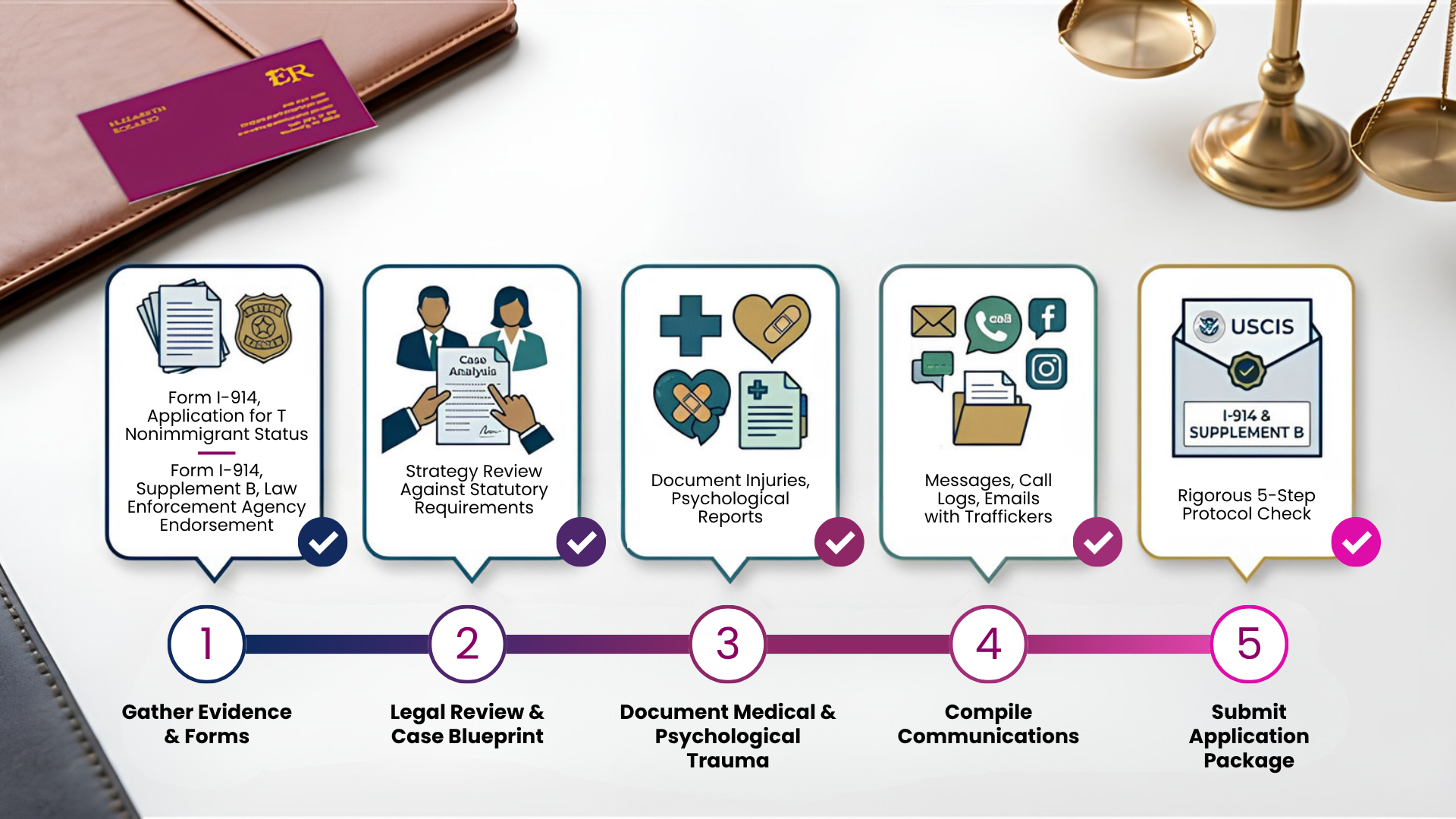
How to Apply for a T Visa: Our 5-Step Process 

Navigating the T Nonimmigrant Status requires meeting high evidence standards. At Elizabeth Rosario Law, we use a trauma-informed strategy to build your case. Our goal is to meet all USCIS requirements while protecting your peace of mind.  

Step 1: Gathering Your Evidence 

The success of your case depends on the quality of your proof. Our team helps you find and secure the following documents: 

  • Official Records: We look for police reports or I-914 Supplement B certifications. 

  • Medical Evidence: We collect records of physical injuries or psychological trauma. 

  • Supportive Proof: We gather witness statements and employment records that show coercion. 

  • Trafficker Communications: We help you organize screenshots of texts, emails, or social media messages. 

Step 2: Expert Legal Strategy 

Having a specialized lawyer increases your chances of approval. Our attorneys make sure your story is consistent. We address every legal requirement to avoid unnecessary delays in your process. 

Step 3: Filing Form I-914 

Form I-914 is the heart of your application. We handle all the technical work to ensure 100% accuracy. This step prevents common "Requests for Evidence" (RFEs) and officially sets your priority date with USCIS

Step 4: Submitting Supporting Exhibits and Legal Briefs 

We do more than just send forms. We submit a detailed Legal Brief. This document explains your "Extreme Hardship" under federal rules. This makes it easier for USCIS officers to verify your eligibility quickly. 

Step 5: Security Clearance and Biometrics 

After we file, USCIS will schedule an appointment for fingerprints and photos. We monitor this stage closely. We ensure the FBI and Department of Homeland Security process your background checks correctly. 

Filling Out Form I-914: What You Need to Know 

Filling out Form I-914 is the most important step in your T Visa process. At Elizabeth Rosario Law, we focus on four key areas. Our goal is to make your application perfect and reduce the risk of a Request for Evidence (RFE) from USCIS

1. Simple and Accurate Information 

USCIS compares your current application with all your past immigration records. We make sure your A-Number, addresses, and entry dates match 100%. Even a small mistake in a date or a previous address can cause long delays. 

2. Your Personal Statement: The Heart of Your Case 

You must provide a detailed statement that tells your story. We help you explain the following clearly: 

  • The Trafficker: Who they are and how they maintained control. 

  • The Tactics: How they used threats, lies, or force to make you work. 

  • The Escape: A clear timeline of how you left the situation or how you were rescued. 

  • The Proof: How your story matches your medical or police records. 

3. Proving Why You Are in the U.S. 

You must show you are in the United States specifically because of the trafficking. This is called the "on account of" rule. If you ever left the U.S. and came back, we help you explain those dates to satisfy USCIS requirements. 

4. Police Help and Trauma Waivers 

While the law usually asks you to help the police, we specialize in Trauma-Based Exemptions. If your trauma makes it too hard to speak to authorities, we provide the clinical documents needed to protect your rights through a trauma exception. 

How We Prevent Application Rejections 

At Elizabeth Rosario Law our "triple-audit" protocol stops technical errors before they happen. We focus on: 

  • Fixing Inconsistencies: We ensure the dates in your story match your work and medical records perfectly. 

  • No Blank Spaces: A blank section can lead to an automatic rejection. We make sure every field is filled correctly (using "N/A" or "None" when needed). 

  • Detailed Narratives: Short or vague answers often lead to RFEs. We provide a full story that meets all federal standards. 

  • Correct Signatures: We check that every form has the right signature to meet current USCIS filing protocols

T Visa Processing Times in 2026 

How long does a T Visa take? While USCIS works to be efficient, human trafficking cases require a very careful review. As of 2026, the average processing time for Form I-914 is between 14 and 18 months. However, more complex cases can take up to 24 months. 

1. The Bona Fide Determination (BFD): Faster Protection 

The Bona Fide Determination is the most important update for survivors. This is an initial review to see if you filed your case in "good faith." It happens shortly after you submit your application

  • Immediate Benefits: If USCIS finds your case is Bona Fide, you can get Deferred Action (protection from deportation). You also receive a Work Permit (EAD) while you wait for the final decision. 

  • Peace of Mind: This policy helps stabilize your life. It supports your mental health by giving you legal work status early in the process. 

2. Why do some cases take longer than others? 

  • Several factors influence the speed of your T Visa immigration process

  • Quality of Evidence: Cases that include a Form I-914 Supplement B (Police Certification) usually move faster through the review stage. 

  • Request for Evidence (RFE): If your application has mistakes or missing info, USCIS will send an RFE. Responding to this can add 3 to 6 months to your total wait time. 

  • Security Checks: Mandatory FBI and DHS screenings can cause delays that are outside of USCIS control. 

  • Office Workload: All T Visa cases go to the Vermont Service Center (VSC). Their current backlog affects how fast they can work on your file. 

3. The 4 Stages of the USCIS Review 

To help you track your case, here are the four main stages: 

  1. Receipt & Intake: USCIS confirms your application is complete and correctly filed. 

  1. Initial Approval (BFD): An officer checks your statement and background to grant a temporary work permit. 

  1. Merits Review: A specialized officer looks deep into your story to verify the facts of force, fraud, or coercion. 

  1. Final Decision: You receive an I-797 Approval Notice or a Notice of Intent to Deny (NOID). If you get a NOID, we have a specific time to provide a legal answer and resolve their concerns. 

From T Visa to Green Card: How to Get Permanent Residence 

Getting a Green Card (Lawful Permanent Residence) is the final step toward a stable life in the United States. If you have a T-1 visa, federal law allows you to apply for this status once you meet specific requirements. 

Requirements for Your Green Card 

To successfully upgrade your status, you must follow these federal rules: 

  • The 3-Year Residency Rule: You must live in the U.S. for three years in a row after your T-1 visa is approved. 

  • Pro Tip: Do not leave the U.S. for more than 90 days at one time (or 180 days total). If you must travel for your trafficking case, we can help you document the exception. 

  • Good Moral Character (GMC): USCIS reviews your conduct while you have your T Visa. It is important to keep a clean record. If you have any legal issues, we can help you file an I-601 Waiver to protect your eligibility. 

  • Ongoing Help for Police: Unless you were under 18 or have a trauma waiver, you must show that you continued to help law enforcement with reasonable requests during your T-1 status. 

How to Apply: The Filing Process 

You make the formal request for residency using Form I-485. At Elizabeth Rosario Law, we build a complete filing package for you, including: 

  • Proof of Status: Your original I-797 Approval Notice. 

  • Updated Statement: A new narrative explaining how you have integrated into the U.S. and why you still need protection. 

  • Medical Exam (I-693): A health report from a doctor certified by USCIS

  • Fee Waiver (I-912): If you qualify, we ensure you do not have to pay the government filing fees. 

Benefits of Becoming a Permanent Resident 

Securing a Green Card transforms your future: 

  • Permanent Work Rights: You no longer have to worry about a visa expiration date to keep your job. 

  • Family Security: You can petition for more family members to join you legally in the United States. 

  • The Path to Citizenship: Most people who get a Green Card through a T Visa can apply for U.S. Citizenship (Naturalization) after five years of residency. 

T Visa vs. U Visa: Which One Is Right for You? 

Choosing between a T Visa and a U Visa is a critical decision. Filing the wrong application can lead to years of unnecessary waiting. While both programs protect victims, they serve different purposes. 

Feature 

T Visa (Trafficking) 

U Visa (Crime Victims) 

Main Focus 

Victims of labor or sex trafficking. 

Victims of qualifying crimes (Domestic violence, assault, etc.). 

Wait Times 

No Backlog. Usually approved in 14-18 months. 

Massive Backlog. Wait times can exceed 5–10 years. 

Annual Limit 

5,000 visas (Rarely reached). 

10,000 visas (Reached every year). 

Police Help 

Optional for minors or those with trauma. 

Mandatory certification from police is required. 

Proof of Harm 

You must be in the U.S. because of trafficking. 

You can be in the U.S. for any reason. 

 1. The "Presence" Rule: Why Are You in the U.S.? 

A major technical difference is the reason why you are currently in the United States. 

  • T Visa (The Connection): To qualify, you must be in the U.S. "on account of" the trafficking. This means you are here because you were brought by force, recruited under false promises, or stayed here after escaping your trafficker. 

  • U Visa (The Crime): There is no "entry rule." You can qualify for a U Visa regardless of how you arrived. The main requirement is that you were a victim of a qualifying crime while in the U.S. 

2. Working with the Police 

Both programs encourage reporting crimes, but the T Visa is more flexible for survivors who are afraid to speak to authorities. 

  • T Visa Exemptions: If you are under 18 or have severe physical or psychological trauma, the law can exempt you from the police cooperation requirement. 

  • U Visa Requirements: There is no "trauma exception" for the U Visa. For your case to move forward, a law enforcement agency must sign a certification (Form I-918 Supplement B) for you. 

3. Which Path Should You Choose? 

In some cases, a survivor might qualify for both. However, because the T Visa has no backlog, it is often the faster way to get a work permit and legal status. 

At Elizabeth Rosario Law, we evaluate your specific situation. We build a strategy that provides the fastest and most secure protection for you and your family. 

Family Reunification: Protecting Your Loved Ones  

The T Nonimmigrant Status recognizes that human trafficking often puts an entire family at risk. Federal law allows the main applicant (T-1) to include specific family members in their case. These family members are known as "derivatives." 

Who can you include in your T Visa application? 

Your eligibility to bring family members depends on how old you are when you file your application

If you are under 21 years old (and unmarried): You can protect a wider range of relatives, including: 

  • T-2: Your spouse. 

  • T-3: Your unmarried children under 21. 

  • T-4: Your parents. 

  • T-5: Your unmarried siblings under 18. 

If you are 21 years old or older: The law is more specific but still protects your immediate family: 

  • T-2: Your spouse. 

  • T-3: Your unmarried children under 21. 

  • New T-6 Classification: In 2026, you may also protect the children of your relatives (for example, your spouse’s children or your grandchildren). This ensures your entire family stays together. 

Special Protection: The "Retaliation Risk" Exception 

What happens if a family member is in danger but does not fit these age rules? If traffickers are threatening your family back home because you escaped or talked to the police, the law can help. Federal rules allow us to include them in the application regardless of their age. 

At Elizabeth Rosario Law, we prioritize these "Retaliation Risk" cases. We help you gather statements and expert reports to show USCIS that your family needs urgent protection. 

How to Apply for Your Family (Form I-914 Supplement A) 

To get legal status for your family, we must file a separate Supplement A for each person. Our team ensures every detail is perfect: 

  • Proving Your Relationships: We help you gather birth and marriage certificates. If your traffickers destroyed these documents, we help you find other ways to prove your family bond. 

  • Background Reviews: We check each family member’s history to ensure they meet U.S. standards. If they have past immigration issues, we prepare the necessary I-192 waivers

  • Protecting Children (CSPA): We use the Child Status Protection Act to ensure your children do not lose their eligibility if they turn 21 while the case is still waiting for a decision. 

T Visa Work Permits: Your Path to Independence 

For survivors of human trafficking, a work permit—formally known as an Employment Authorization Document (EAD)—is a vital tool for independence. In 2026, understanding the timing of your permit is a key part of your legal strategy. 

How Do You Get a Work Permit? 

Under current USCIS rules, there are two main ways to get your permit during the T Visa process: 

  1. Early Access (Bona Fide Determination): Shortly after you file your case, USCIS performs an initial review. If they find your application is complete and filed in "good faith," you can receive a work permit before your T Visa is fully approved. This allows you to support yourself while your case is waiting for a final decision. 

  1. Full Approval: Once USCIS officially approves your Form I-914, you receive T-1 status. This legal status automatically gives you the right to work anywhere in the United States. 

Important 2026 Updates: Renewal and Validity 

The rules changed recently. It is vital to stay ahead of these dates to avoid losing your job: 

  • 18-Month Validity: In 2026, many new work permits last for 18 months instead of four years. This change allows the government to perform more frequent security checks. 

  • No Automatic Extensions: A major update in late 2025 ended many "automatic extensions." This means if your card expires, you may lose your right to work immediately. You must have a new card in hand to continue working. 

  • The 180-Day Rule: At Elizabeth Rosario Law, we manage this for you. We file your renewal (Form I-765) exactly 180 days before your card expires. This proactive step ensures you never have a gap in your employment. 

Your Rights as a Work Permit Holder 

Once you have your approved work permit, you gain these legal rights: 

  • Work Anywhere: You can work for any employer in the U.S. You do not need a "sponsor." 

  • Start a Business: You are free to change jobs or start your own business whenever you like. 

  • Social Security (SSN): Your permit allows you to get a Social Security Number. This is necessary for banking, paying taxes, and building credit in the U.S. 

Pro Tip for Employers: To stay legal, you must show your unexpired card to your employer for I-9 verification. We always recommend keeping a digital scan of your card in a safe place. 

Do I Have to Report the Crime to the Police? 

A common fear for many survivors is the requirement to help the police. To qualify for a T Visa, you generally must be willing to help federal, state, or local authorities investigate human trafficking crimes. 

1. What does "Cooperation" look like? 

Helping law enforcement does not always mean testifying in a high-profile trial. It can take many forms, such as: 

  • Sharing Information: Telling authorities what you know about traffickers and their operations. 

  • Interviews: Participating in private meetings with investigators to share your story. 

  • Identification: Helping the police identify other victims or witnesses. 

  • Ongoing Help: Assisting with active cases to help stop the abuse of others. 

2. Important Exceptions: When You Do Not Have to Cooperate 

The law recognizes that for some survivors, talking to the police is impossible due to age or the severity of the abuse. There are two major T Visa exceptions

  1. The Age Exception (Minors): If you were under 18 at the time of the trafficking, you are not required to help law enforcement to qualify for a T Visa. Your safety and recovery as a minor are the main priority. 

  1. The Trauma Exception: If you are an adult but cannot help because of severe physical or mental trauma, you may be exempt. At Elizabeth Rosario Law, we work with doctors and mental health experts to document your trauma and secure this trauma waiver for you. 

3. Balancing Your Safety and the Law 

Federal rules ensure that T Visa law enforcement cooperation remains reasonable. You should never be forced to help in a way that puts you or your family in immediate danger. We advocate for your safety. Our team ensures that your rights as a survivor come first throughout the entire legal process. 

T Visa Costs and Access to Social Benefits 

A key part of the T Nonimmigrant Status is removing financial barriers to justice. The process is designed so that your recovery is never slowed down by government costs or the fear of being a "public charge." 

How much does a T Visa cost? 

The good news is that applying for a T Visa is generally free. USCIS knows that trafficking survivors often lack money due to their exploitation. 

  • Free Applications: In 2026, Form I-914 and your work permit application (Form I-765) are fee-exempt. This means you do not have to pay government filing fees as the main applicant. 

  • Biometric Services: The fees for fingerprints and background checks are also waived. This ensures you can enter the legal system without financial stress. 

  • Fee Waivers (Form I-912): If a fee applies to other related forms, our team at Elizabeth Rosario Law helps you file a fee waiver based on financial hardship. We work to ensure you do not pay out of pocket. 

Access to Federal Benefits and Support 

Under the Trafficking Victims Protection Act (TVPA), survivors with a T Visa—or even an initial Bona Fide approval—get the same benefits as refugees. This support gives you the stability you need to rebuild your life. 

1. Financial and Food Security 

You may qualify for programs that provide immediate cash and healthy food: 

  • Cash Assistance: Programs like TANF and SSI help you pay for safe housing and basic needs. 

  • Food Assistance: Programs like SNAP and WIC ensure you and your children have access to nutritious meals. 

2. Full Healthcare Coverage 

Access to Medicaid ensures that the cost of your medical recovery is covered. This includes: 

  • Emergency medical care. 

  • Specialized trauma counseling. 

  • Ongoing physical and mental health support. 

3. Specialized Services (ORR) 

Through the Office of Refugee Resettlement (ORR), you can access a support network for your long-term success: 

  • Case Management: Personal help navigating your new life in the U.S. 

  • Job Training: Classes to learn new skills and English to help you join the workforce. 

4. Will these benefits hurt my future Green Card? 

No. It is a common myth that getting help will hurt your immigration case. T Visa holders are exempt from "Public Charge" rules. Using these benefits will not negatively affect your future Green Card application or your path to citizenship. 

T Visa Approval Rates: What are your chances in 2026?  

Looking at the T Visa approval statistics for 2026 shows a very positive outlook for survivors. If you submit a high-quality application, your chances of success are high. Unlike other immigration paths, the T Visa remains one of the most reliable options for those who qualify. 

2026 Success Trends 

Current data from the Vermont Service Center (VSC) shows that even as more people apply, the approval ratio stays strong: 

  • High Success After Initial Review: About 88% of cases that pass the initial Bona Fide Determination (BFD) move on to full approval. 

  • No Lottery, No Waiting List: There is a limit of 5,000 T Visas each year, but the government rarely reaches this limit. This means there is no "lottery." Your approval depends on the strength of your evidence, not on luck or a random draw. 

What makes a T Visa case successful? 

Statistics show that the strongest cases—the ones that avoid a Request for Evidence (RFE)—usually have these three things: 

  • Detailed Evidence: Successful applications include a strong Legal Brief. This document connects your personal story directly to the legal rules regarding force, fraud, or coercion. 

  • Law Enforcement Support: Including a Supplement B (Law Enforcement Certification) is not mandatory, but it helps. It significantly speeds up the process and reduces the need for extra checks. 

  • Proactive Waivers: Filing an I-192 waiver at the start helps address any past immigration issues. This prevents "technical denials" later in the process. 

T Visa Attorney Advice: Why Legal Representation Matters?  

Choosing an attorney for your T Visa consultation is the most important decision in your journey. In 2026, USCIS checks applications more strictly than ever. The difference between a denial and a life-changing approval often depends on the legal strategy and the empathy of your legal team. 

How Elizabeth Rosario Law Protects You 

We do more than just fill out forms; we engineer outcomes. Our approach to your case is built on three pillars: 

  • Trauma-Informed Care: We know that sharing your story is difficult. Our intake process is designed to gather the facts we need without causing you more pain. Your emotional well-being is our priority. 

  • Professional Precision: We navigate complex federal rules to find the exact evidence of force, fraud, or coercion that USCIS officers look for. We ensure every technical detail in your file is perfect. 

  • Custom Legal Briefs: Every case is unique. We write a custom "roadmap" for the government officer. This document explains your eligibility and why you meet the "Extreme Hardship" standard. 

Finding an Advocate Who Speaks Your Language 

Experience and cultural understanding are essential when choosing a lawyer. At Elizabeth Rosario Law, cultural support is part of our DNA. 

  • Bilingual Excellence: You should never worry about a language barrier. We communicate with you in your preferred language. This ensures nothing is lost in translation on your path to justice. 

  • Cultural Competence: We understand the unique social and cultural contexts that traffickers exploit. This allows us to build your application with more depth and authenticity. 

T Visa Interview Tips: How to Prepare 

While USCIS may waive the interview for many trafficking survivors, you must be prepared if they request a "Merits Review." Do not think of the interview as a test. Instead, see it as a chance to tell your story in person and strengthen your case. 

The Elizabeth Rosario Rule: You Are Not Alone 

At Elizabeth Rosario Law, our work comes from a deep, personal understanding of the immigrant journey. The Rosario family’s own path to citizenship reminds us every day that hard work pays off. We help you prepare for your interview with that same spirit of faith and professional excellence. 

1. How We Prepare You for Success 

The key to a successful T Visa interview is being clear and consistent. Even though USCIS officers have training in "trauma-informed" interviewing, they still need specific facts. We help you in three main ways: 

  • The Application Audit: We review your Form I-914 and Legal Brief with you. It is very important that you remember the dates, locations, and names from your original application. 

  • Managing Memory and Trauma: It is normal for survivors to have gaps in their memory due to trauma. We help you prepare for questions about dates that might not perfectly match. We also provide the context USCIS needs to understand why these gaps exist. 

  • Interpretation Support: We ensure you have high-quality language support. This makes sure you tell your story accurately, without any language barriers. 

2. What Will the USCIS Officer Ask? 

Most interviews focus on four main areas. Knowing what to expect will give you confidence: 

  1. Trafficking Details: They will ask how someone recruited you, what work you did, and how the traffickers controlled you. 

  1. Your Presence in the U.S.: You must show that you are in the United States specifically because of the trafficking (the "on account of" rule). 

  1. Law Enforcement Cooperation: The officer will review how you helped the police. If you could not help, we will discuss your trauma waiver

  1. Background Check: This is a final review of your history to ensure you meet all standards for approval. 

Next Steps: Your Journey Toward Safety  

The T Visa program is more than just a legal status; it is a doorway to hope and protection. From meeting the first T Visa requirements to getting your Green Card, every step is a chance to build a secure future in the United States. 

Whether you are just learning how to apply or are already waiting for a decision, remember that you do not have to do this alone. The benefits and social services available to you are a foundation for your recovery. Our specialized legal team ensures your rights stay protected under federal law. 

Challenges like language barriers or the fear of talking to the police should never stand in the way of your safety. With the right legal strategy and a case built on precision and empathy, the T Visa is one of the most powerful tools for changing your life. 

Ready to Take the Next Step? Reclaim Your Future Today! 

Take the first step toward your new life. Contact Elizabeth Rosario Law today for a confidential, trauma-informed consultation. Let’s discuss your options for T Visa protection and secure your legal status together. 

Disclaimer: Este contenido es solo para fines informativos generales y no constituye asesoramiento legal. Las leyes de inmigración cambian frecuentemente y la información aquí puede no reflejar los desarrollos legales más recientes. Consulte a un abogado para obtener asesoramiento sobre su situación específica.

Immigration: T-VISA Requirements
T-Visa vs U-Visa
Human Trafficking Visa
Trafficking Victim
T-Visa benefits
T-Visa residency
T-Visa work permit
E

Elizabeth Rosario

Author

Immigration Attorney with 14+ years of experience helping families navigate complex immigration matters.

Abogada de InmigraciónLicensed Attorney

Boletín Informativo

Suscríbase a nuestro boletín para recibir actualizaciones importantes sobre leyes migratorias y recursos para su caso.

Respetamos su privacidad. Puede cancelar su suscripción en cualquier momento.

¿Necesita Orientación en Inmigración?

Nuestro equipo experimentado está listo para ayudarle con sus asuntos de inmigración. Obtenga una evaluación gratuita de caso hoy.

Llame Ahora