How to Submit a VAWA Application in 2026
Learn how, under the Violence Against Women Act (VAWA), to submit a VAWA application in 2026, including Form I-360, requirements, documents, work permits, processing times, interviews, and what happens after approval.
How to Submit a VAWA Application in 2026
If you are living abuse and your immigration status depends on a family member, you may be searching for answers about the VAWA application process in 2026. This guide explains how to submit a VAWA application, the Form I-360 self-petition steps, the documents commonly used in VAWA cases, processing timelines, interview questions, privacy protections, and what happens after approval. Many survivors ask similar questions:
What is Form I-360?
Who qualifies for a VAWA self-petition?
Can I get a work permit through VAWA?
Will my abuser find out if I apply for VAWA?
Is VAWA only for Women?
A VAWA self-petition allows eligible applicants to file directly with U.S. Citizenship and Immigration Services (USCIS) to request lawful immigration status, work authorization, and eventually a green card.

Frequently Asked Questions
What is VAWA application?
A VAWA application is a self-petition filed under the Violence Against Women Act that allows certain survivors of abuse to apply for immigration benefits independently.
Who qualifies for VAWA?
Certain spouses, children, and parents of U.S. citizens or lawful permanent residents may qualify if they experienced battery or extreme cruelty.
Can I file a VAWA without a lawyer?
Yes. Immigration law does not require applicants to hire a lawyer. However, many applicants work with an immigration attorney because VAWA cases often involve detailed evidence and legal requirements.
How much does a VAWA application cost?
Filing costs may vary depending on the forms submitted with the case, including work authorization or adjustment of status applications.
What documents do I need for VAWA?
Common evidence includes identity records, relationship documents, shared residence evidence, police reports, medical records, affidavits, and digital evidence.
Is VAWA still active in 2026?
Yes. The Violence Against Women Act continues to provide immigration protections for eligible survivors in 2026.
Is VAWA the same as a restraining order?
No. A restraining order is generally issued through local or state courts for immediate protection. A VAWA self-petition is a federal immigration process handled through USCIS.
What Is Form I-360?
Form I-360 is the official immigration form used for a VAWA self-petition. Survivors of battery or extreme cruelty may use this form to apply for immigration protection independently.
The form is filed with U.S. Citizenship and Immigration Services and allows eligible applicants to request immigration benefits without relying on the abusive spouse, parent, or child.
In many VAWA cases, Form I-360 is the first major step toward:
Lawful immigration status
Work authorization
A Social Security number
Adjustment of status
Permanent residence in the United States
A future green card application
The I-360 form may also be called:
Form I-360
I-360 petition
I-360 self-petition
VAWA petition
VAWA form
Many people searching online for “i-360 form,” “form i-360 pdf,” or “vawa application process” are usually looking for information about this exact filing process.
“Después de lo que me pasó, llegué a pensar que ya no tenia opciones. Cuando la Abogada Elizabeth me explicó que todavía existían caminos, recuperé la esperanza”. — Maria, Cliente de Elizabeth Rosario Law, PLC.
Who Can File a VAWA Self-Petition?
A person may qualify for a VAWA self-petition if they experienced battery or extreme cruelty committed by a U.S. citizen or lawful permanent resident family member.
VAWA protections may apply to:
Spouses of U.S. citizens
Spouses of lawful permanent residents
Children abused by a U.S. citizen parent
Children abused by a green card holder parent
Parents abused by a U.S. citizen son or daughter
Certain former spouses may also qualify if:
The marriage ended within the last two years
The abuse was connected to the divorce
The Violence Against Women Act protects women, men, and non-binary individuals. Although the law contains the word “women,” immigration protections are available regardless of gender.
Documents Needed for a VAWA Application
One of the most common questions in VAWA cases is: “What documents do I need for VAWA?”
U.S. Citizenship and Immigration Services reviews the totality of the evidence submitted with the petition. Different immigration cases require different supporting records, but most VAWA applications include documents related to:
Identity
Family relationship
Shared residence
Battery or extreme cruelty
Good moral character
Common VAWA evidence includes
Proof of Relationship
Applicants commonly submit:
Marriage certificates
Birth certificates
Divorce records
Children’s birth certificates
Passport copies
Green card copies
Proof of Shared Residence
Applicants may use:
Lease agreements
Utility bills
Joint bank statements
Insurance records
School records
Medical records
Mail addressed to both parties
Evidence of Battery or Extreme Cruelty
Physical violence is not required in VAWA cases. USCIS may also consider emotional abuse, financial control, threats related to immigration status, and coercive behavior.
Evidence may include:
Police reports
Medical records
Therapy records
Counseling records
Protective orders
Restraining orders
Photographs
Personal affidavits
Witness statements
Emails and text messages
Digital evidence showing threats or harassment
Evidence of Good Moral Character
Applicants may also submit:
Police clearance letters
Background checks
Tax records
Employment records
Community reference letters
Religious or volunteer organization letters
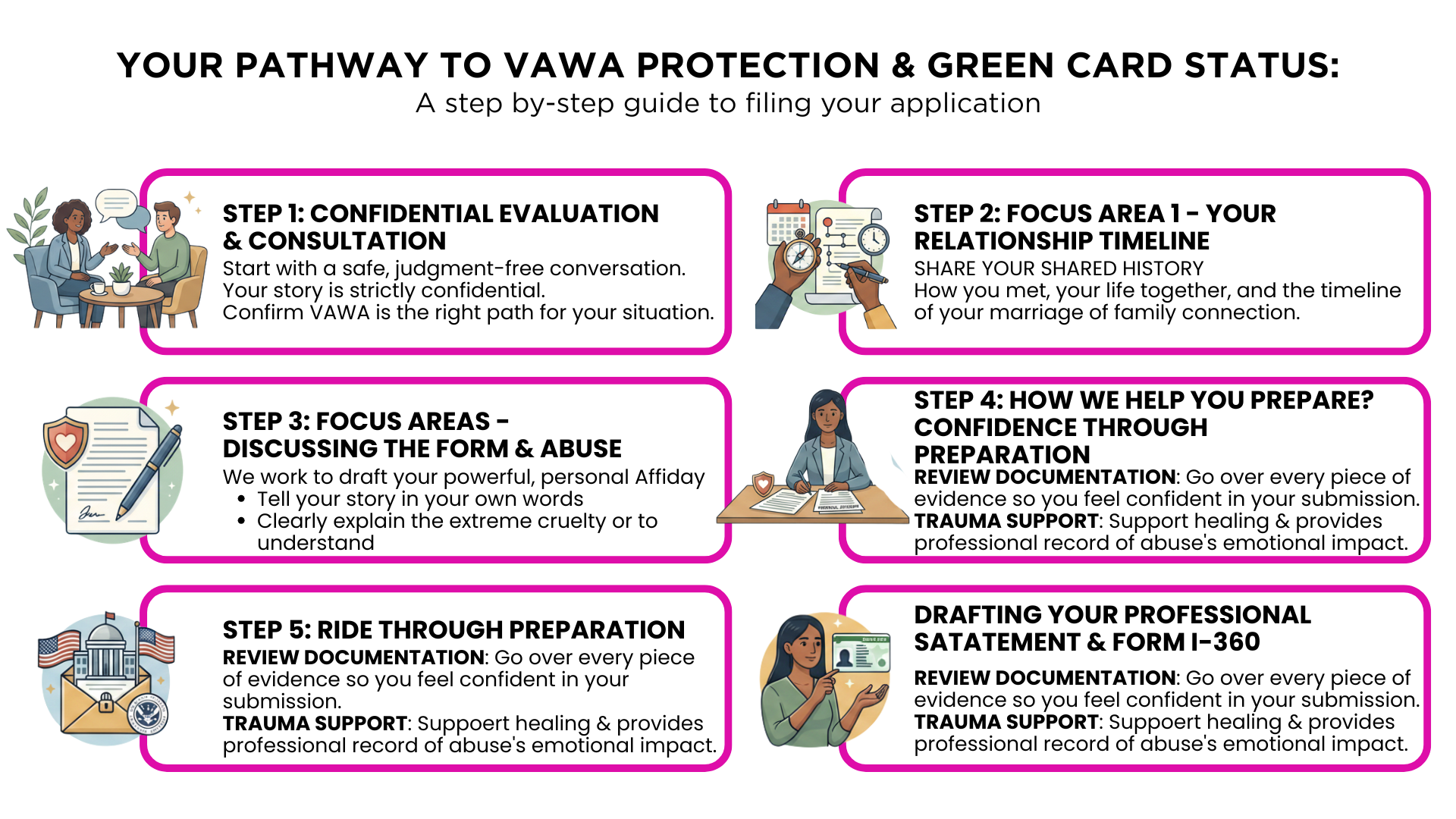
Step-by-Step VAWA Application Process
Many survivors search for “how to submit my VAWA application” because they want a clear explanation of the filing process.
Although every immigration case is different, most VAWA applications follow similar steps.
Step 1: Prepare the VAWA Self-Petition
The first step is preparing Form I-360 and gathering supporting evidence.
This stage usually includes:
Reviewing immigration history
Collecting supporting documents
Preparing personal affidavits
Organizing evidence of abuse
Identifying safe mailing addresses
Reviewing prior immigration filings
Many applicants also prepare forms related to:
Work authorization
Adjustment of status
Travel documents
Strong organization matters in VAWA cases because USCIS officers review both the evidence and the consistency of the information provided.
Step 2: File the Application With USCIS
The VAWA self-petition is submitted directly to a specialized USCIS unit that handles humanitarian immigration cases.
Many applicants searching for “i-360 filing address” are trying to identify the correct USCIS filing location for Form I-360 submissions.
After filing, USCIS may issue:
Receipt notices
Biometrics appointments
Requests for Evidence (RFEs)
Prima facie determination notices
Privacy protections are extremely important during this stage. Federal law generally prohibits immigration officials from disclosing VAWA case information to the abusive family member.
Step 3: Wait for Processing and Case Review
After filing, USCIS reviews:
The qualifying relationship
Shared residence
Supporting evidence
Immigration history
Background checks
Good moral character
Some applicants receive Requests for Evidence if USCIS needs additional documentation.
Processing times vary depending on:
Case complexity
USCIS workload
Prior immigration filings
Background checks
Adjustment of status eligibility
Some applicants may later attend a VAWA interview, while others may receive approval without one.

What Is a Prima Facie Determination?
A prima facie determination is a temporary notice issued by USCIS in some VAWA cases.
This notice means USCIS believes the applicant has submitted enough initial evidence to establish a basic case for eligibility under the Violence Against Women Act. A prima facie determination is not a final approval. However, it may help some applicants access certain public benefits or support services while the case remains pending.
Not every VAWA applicant receives a prima facie determination notice.
How Long Does a VAWA Application Take?
One of the most searched questions online is: “How long does VAWA take?”
VAWA processing times vary depending on:
USCIS case volume
Background checks
Requests for Evidence
Immigration history
Adjustment of status eligibility
Local office processing
Some applicants also search:
“How fast is VAWA approved?”
“How long does VAWA application take?”
“I-360 approved what next?”
Because immigration processing times frequently change, applicants often monitor USCIS updates throughout the process.
Can I Include My Children?
Yes. Certain unmarried children under 21 may qualify as derivatives in a VAWA self-petition.
Many people search for “VAWA derivatives rules children” because they want to know whether their children may receive immigration benefits through the case.
Children may qualify for benefits connected to the parent’s VAWA petition even if they were not direct victims of abuse.
In some situations, stepchildren may also qualify if the marriage creating the stepparent relationship occurred before the child turned 18.
Immigration law may also allow certain applicants to file until age 25 if the abuse contributed to the filing delay.
Will My Abuser Find Out?
Privacy is one of the biggest concerns in VAWA cases.
Many survivors ask: “Will my abuser find out if I apply for VAWA?”
Federal confidentiality laws generally prohibit USCIS from sharing information about a VAWA application with the abusive family member.
USCIS also uses special confidentiality protections in many VAWA cases, including:
Restricted file access
Confidential mailing procedures
Protected case information
Separate humanitarian case handling
Applicants often use:
Safe mailing addresses
P.O. boxes
Attorney office addresses
These privacy rules exist because immigration law recognizes the safety concerns involved in domestic violence cases.
What Happens at the Interview?
Some VAWA self-petitions are approved without an interview. In other immigration cases, USCIS may schedule an interview to verify eligibility requirements.
Many applicants search for “VAWA interview questions” because they want to understand the process before attending an appointment.
A USCIS officer may ask questions about:
The relationship history
Shared residence
Marriage details
Immigration history
Supporting documents
Battery or extreme cruelty allegations
Questions about abuse may involve:
Emotional abuse
Financial control
Threats related to immigration status
Physical violence
Coercive behavior
The purpose of the interview is generally to confirm the information included in the petition and supporting evidence.
Several outcomes are possible after the interview. For a complete explanation of Green Card Delays, Waivers & Residency Risks in 2026, see our guide: Green Card Delays, Waivers & Residency Risks in 2026.
What Happens After I-360 Approval?
After USCIS approves Form I-360, many applicants may move to the next immigration stage.
Depending on the case, approved applicants may become eligible to:
Apply for adjustment of status
Submit a green card application
Request work authorization
Continue immigration processing in removal proceedings
Seek lawful permanent residence
The next step often depends on:
Visa availability
Immigration history
Entry records
Current immigration status
Prior immigration violations
Some applicants receive permanent residence shortly after approval, while others continue through additional immigration processing stages.
Can I Get a Work Permit Through VAWA?
Yes. Some applicants may qualify for work authorization during the VAWA application process.
Many survivors search for “can I get a work permit through VAWA” because financial independence is often a major concern in abusive relationships.
Applicants may qualify to file Form I-765 for work authorization depending on:
The stage of the VAWA case
Adjustment of status eligibility
Immigration history
Current immigration status
A work permit may allow eligible applicants to:
Work legally in the United States
Apply for a Social Security number
Obtain a driver’s license in many states
Build financial independence
Employment records connected to work authorization are generally separate from the details of the abuse allegations contained in the VAWA petition.
Speak With a VAWA Licensed Immigration Attorney
VAWA applications often involve complex immigration supporting evidence. At Elizabeth Rosario Law, our Licensed Immigration Attorneys help victims understand their legal options, prepare supporting documentation, and understand strict filing procedures; for Green Card applications, family-based petitions, adjustment of status cases, waivers, U Visa, T 1 Visa, VAWA petitions, and other immigration process; we are ready to listen.
Eligibility for immigration benefits depends on your facts, evidence, and the applicable immigration laws. If you have questions about an upcoming USCIS interview, 📞 Schedule Your FREE Evaluation Today. Our licensed immigration attorneys are ready to discuss your options and help you.
Call Our National Consult Line: (855) 627-2292
We proudly serve clients across all 50 states from our primary offices in Wyoming, Michigan, and Charlotte, North Carolina.
Disclaimer: This content is for general informational purposes only and does not constitute legal advice. Immigration laws and USCIS procedures change frequently. Consult a qualified immigration attorney regarding your individual situation.

Disclaimer: Este contenido es solo para fines informativos generales y no constituye asesoramiento legal. Las leyes de inmigración cambian frecuentemente y la información aquí puede no reflejar los desarrollos legales más recientes. Consulte a un abogado para obtener asesoramiento sobre su situación específica.
Elizabeth Rosario
Immigration Attorney with 14+ years of experience helping families navigate complex immigration matters.
Boletín Informativo
Suscríbase a nuestro boletín para recibir actualizaciones importantes sobre leyes migratorias y recursos para su caso.
Respetamos su privacidad. Puede cancelar su suscripción en cualquier momento.