Will my abuser find out if I apply for VAWA?
This is one of the most important questions victims of domestic violence ask when considering immigration protection through the Violence Against Women Act (VAWA). The short answer is no.
Will my abuser find out if I apply for VAWA?
No, United States Citizenship and Immigration Services (USCIS) has strict confidentiality policies designed specifically to protect VAWA applicants from their abusers. In fact, there are federal laws, specifically 8 U.S.C. Section 1367, that prohibit the Federal Government from sharing any information about your case with the person who harmed you. At Elizabeth Rosario Law, we are here to ensure that your path to a new immigration status is kept private and secure in every step of the way.
What is VAWA?
The Violence Against Women Act (VAWA) is a powerful federal law that allows certain non-citizens who have been victims of domestic violence or extreme cruelty to seek legal status in the United States independently.
In a typical family-based green card process, the United States citizen or permanent resident spouse “holds the power” by filing the paperwork. VAWA cases change that, it allows you to “self-petition” meaning you apply for your own Green Card without the abuser ever knowing, participating, or having any control over your legal status.
These protections exist because immigration attorneys understand that abusers often use a person's immigration status as a tool of “threat and control” VAWA is designed to take that tool away and give you back your voice.
How does VAWA keep you safe?
Confidentiality: Law enforcement employees can face heavy fines or even lose their jobs if they share your information with your abuser or their family.
A “Safe” Address: You can provide a separate mailing address (like a P.O. Box or your attorney’s office) so that no correspondence from immigration ever arrives at the place you share with an abuser.
Independent Process: You do not need the abuser’s signature, their physical presence at interviews, or even their knowledge to win your case.
No Contact Rules: Immigration officers are strictly prohibited from contacting your abuser to “verify” information. ICE agents know that doing so would put you in danger.
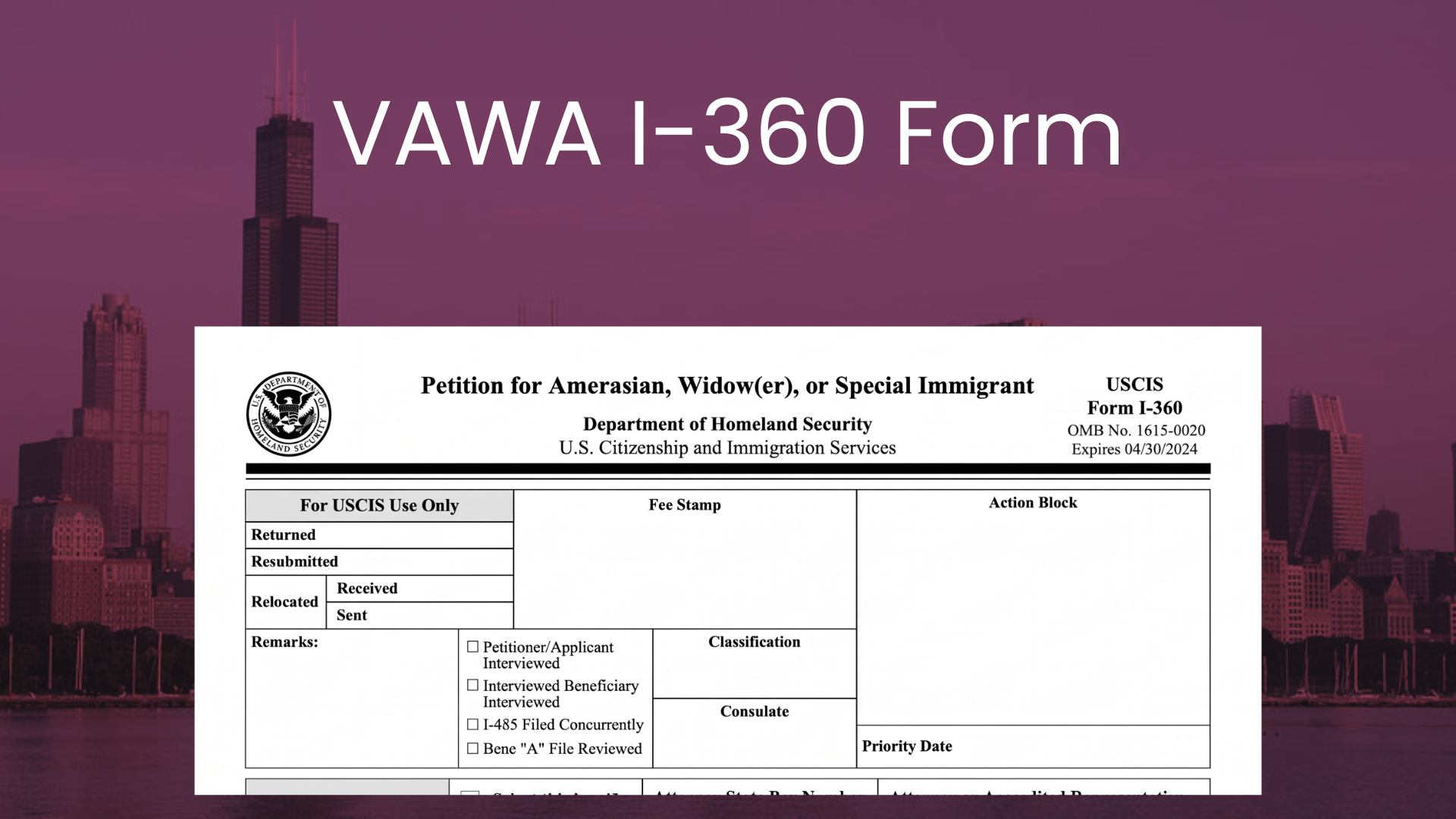
VAWA isn't just an i-360 form; it is a shield. It allows you to move from a place of fear to a place of legal security.
How Do I Know If I Qualify?
The name “Violence Against Women Act” makes people think it’s only for women, but that is a common misconception. At Elizabeth Rosario Law, we want you to know that VAWA is for everyone. Your civil rights do not depend on your gender, age, or sexual orientation. If you have been harmed, the VAWA is designed to protect you.
VAWA Eligibility Requirements
To see if VAWA is the right path for you, take a look at a few key areas we put together. To qualify, you need to meet these four criteria:
The Relationship: You are (or were) the spouse, child, or parent of a U.S. citizen or a Lawful Permanent Resident (Green Card holder). This also includes those who divorced their abuser within the last two years, as long as the abuse was a reason for the divorce.
The Abuse: You have suffered “battery” (physical harm) or “extreme cruelty” (emotional or mental harm) at the hands of that abuser.
Shared Residence: You lived with the abuser at some point in time. It doesn’t have to be right now, but there must have been a shared home.
Good Moral Character: This is a legal way of saying you are a kind, law-abiding person. We help you demonstrate this through your history and community standing.
1. “He never hit me, but he controlled everything—does that count?”
Absolutely. One of the most important things to understand is that domestic violence isn’t always about physical bruises. Many survivors tell us, “But they never laid a hand on me”. Under VAWA, extreme cruelty is a broad term that covers many forms of non-physical harm.
You may qualify if you have experienced:
Emotional & Psychological Abuse: Constant belittling, insults, or making you feel like you are “crazy”.
Financial Control: Taking your paycheck, preventing you from working, or refusing to give you money for basic needs like food or medicine.
Threats & Intimidation: Threatening to call ICE, threatening to take your children away, or hurting pets to scare you.
Isolation: Not letting you see your friends or family, or monitoring your phone and social media constantly.
Forced Dependence: Using your immigration status as a way to keep you trapped in the relationship.
How to submit my VAWA application?
If any of this sounds like what you are going through, please know that you are a survivor, and these actions are recognized by federal law as abuse. You don't have to wait for things to “get worse” to seek help and protection.
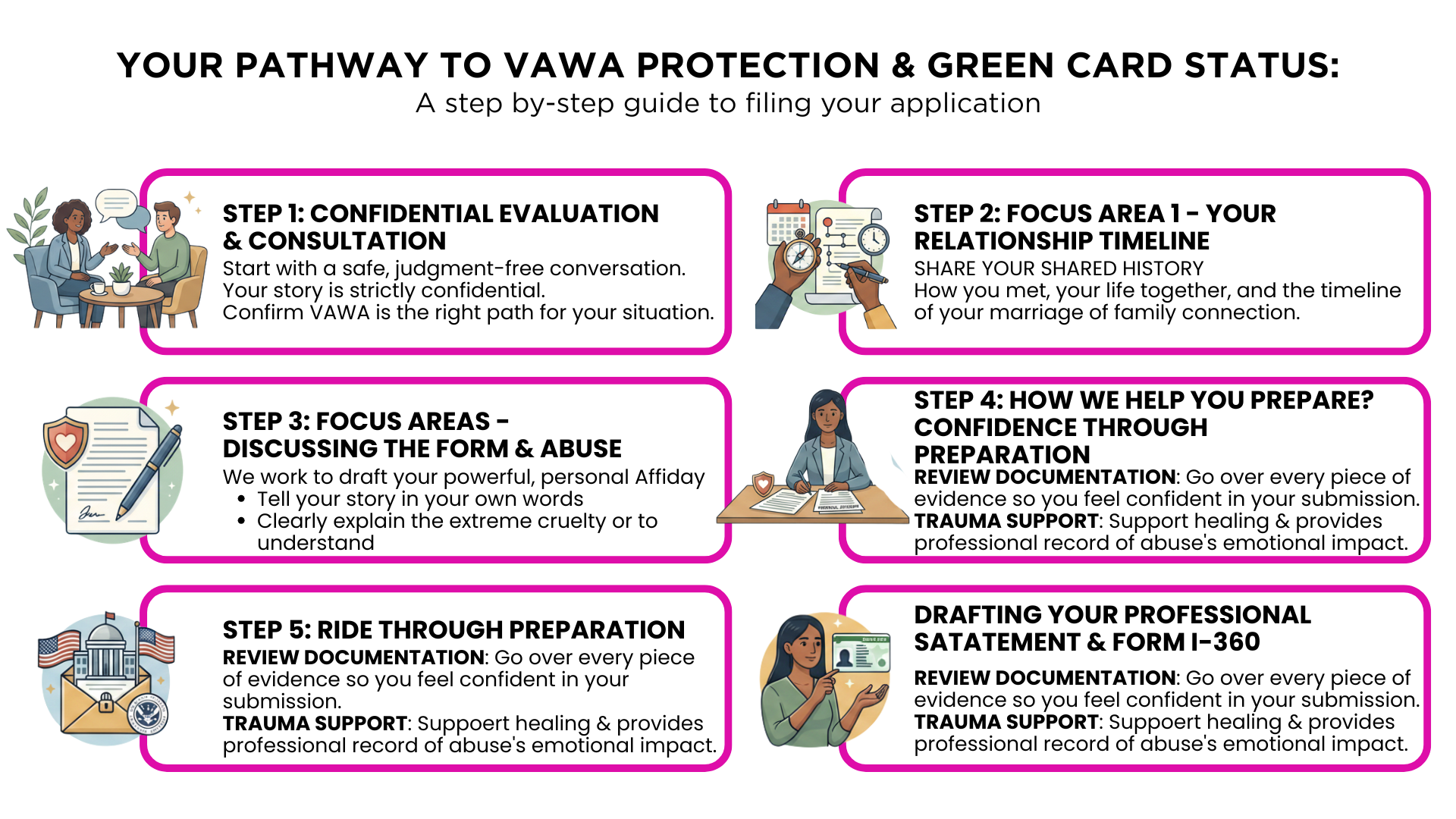
Taking the first step toward legal status can feel like a mountain to climb, but you don’t have to do it all at once. At Elizabeth Rosario Law, we break this down into small, manageable steps to ensure you feel safe and supported from start to finish. Our immigration lawyers handle the heavy lifting of search for legal status so you can focus on your healing. Here is exactly how we move forward together:
Step 1: A Safe and Private Conversation
Everything starts with a confidential evaluation. This is a judgment-free zone where you can tell your story, we listen to the details of your situation to confirm that VAWA is the best path for you.
Step 2: Gathering the Pieces of Your Story
Evidence is what builds your “shield”. We will help you collect the necessary documentation, don't worry if you don't have “perfect” records, we know that in many cases, abusers hide or destroy documents:
Proof of the relationship: Marriage certificates or birth certificates.
Proof of living together: Lease agreements, utility bills, or even mail addressed to both of you.
Proof of the abuser’s status: Copies of their United States passport or Green Card.
Evidence of the abuse: This can include medical records, police reports, or text messages. If you don't have these, your own detailed statement (affidavit) and letters from people who know you are incredibly powerful.
Step 3: Preparing Your Voice (Form i-360)
The heart of your application is the form i-360. We work with you to draft a detailed "affidavit"—this is your personal statement where you tell your story in your own words. We make sure it clearly explains the "extreme cruelty" or "battery" you experienced so the immigration officers understand the reality of your situation.
Step 4: Confidential Filing with USCIS
Once your application is perfect, we file it directly with a special unit at USCIS that only handles VAWA cases. These officers are specifically trained to work with survivors. Most importantly, this is filed without your abuser ever being notified. We use a safe mailing address so that no receipts or fingerprint appointments ever arrive at the home where your abuser might see them.
Step 5: The Path to Your Green Card
Once your VAWA petition is approved, we have reached a major milestone! This approval often allows you to apply for an “Adjustment of Status” to become a Lawful Permanent Resident. This is the final step toward becoming a green card holder.
Can Men Qualify for VAWA?
It is a very common myth that VAWA is “only for women”. We want to be very clear: Abuse does not discriminate, and neither does the law. At Elizabeth Rosario Law, we have helped many men find safety and legal status through VAWA self-petition. Whether you are a husband, a son, or a father, you have the exact same rights to protection as any other survivor. If you are experiencing "extreme cruelty" or physical harm from a United States citizen or Green Card holder spouse or parent, you can stand up for yourself and apply. You are not alone, and there is no shame in seeking a life of peace.
I’m already divorced—can I still apply?
Yes, you can. We know that sometimes the only way to stay safe is to leave the marriage first. If you are already divorced, you can still file a VAWA self-petition as long as:
You file within two years of the divorce being finalized.
You can show that the abuse was connected to the reason for the divorce.
1. Including your children in your case
When you seek safety, we know your first thought is often about your children. The good news is that you don’t have to leave them behind in the process. You can include your unmarried children (under the age of 21) in your VAWA petition. This includes:
Your biological children.
Children your abuser adopted.
Children you adopted together.
Step-children (in many circumstances).
Just like you, your children will be covered by the confidentiality rules. Their names and information will be kept safe from the abuser, ensuring the whole family can move toward a brighter future together.
2. Parent-Child abuse cases
Sometimes the abuser isn't a spouse, but a parent. If you are under the age of 21 (and in some cases up to age 25) and your United States citizen or Green Card holder parent has abused you, you may qualify for VAWA self-petition. We understand how painful and complicated family dynamics can be, and we are here to help you navigate the specific rules that apply to these sensitive cases.
Can I Get a Work Permit Through VAWA?
One of the most powerful tools an abuser uses is “economic abuse”. By controlling your money, preventing you from working, or keeping you from having a bank account, they try to make it feel impossible for you to leave. At Elizabeth Rosario Law, we want you to know that the law provides a path to your own paycheck and your own independence.
When can I start working legally?
The great news is that you don’t have to wait until your entire case is finished to gain the legal right to work. You can apply for work authorization immediately when you file your VAWA self-petition. By filing Form i-765 (Application for Employment Authorization) at the same time as your VAWA petition, you are putting yourself on the fastest track to independence.
1. A work permit provides more than just a job:
A Legal Identity: The legal right to work anywhere in the United States.
Your Own Social Security Number: This is a vital step in building your own credit and history.
Mobility: In most states, having an approved work permit or pending VAWA case makes you eligible for a driver's license.
Freedom: Real financial independence from your abuser.
2. Your Privacy is Protected at Work
Many survivors worry that a future employer might find out about their situation. Under VAWA, your privacy follows you into the workplace:
Strict Confidentiality: Employers receive your work permit card, but they do not receive any information regarding the fact that it was obtained through a VAWA case.
Discreet Renewals: When it’s time to renew your permit, the process is handled with the same high level of confidentiality as your original application.
Separation of Records: Your employment records are kept entirely separate from the sensitive details of your abuse documentation.
3. How USCIS Protects Your Sensitive Documents?
Because a VAWA filing is done without the abuser's consent or knowledge, USCIS treats your file with “high-security” protocols. They understand that if this information fell into the wrong hands, it could be dangerous.
Restricted Access: Your file is kept in a secure, restricted-access system that is separate from standard immigration files.
Limited Eyes: Only specifically trained authorized personnel who understand the sensitivity of domestic violence cases are allowed to view your records.
4. Safe Communication & Address Confidentiality
Your safety depends on the abuser not finding out about your application. USCIS follows strict “safe-contact” protocols:
Your Safe Address: All mail goes only to the address you choose. This can be a P.O. Box or our law office.
No Unwanted Calls: USCIS will never call you at your workplace if you haven't authorized it, and they will only use the phone numbers you provide.
Flagged for Safety: Your records are “flagged” in the system to ensure that your residential address is never shared with other federal government databases or included in public court documents.
What Happens to My Children if I Apply to VAWA?
As a parent, your first thought is always, "Is my child safe?" At Elizabeth Rosario Law, we know that the fear of losing your children or having them separated from you is often what keeps survivors from seeking help. When you apply for VAWA, you aren't just opening a door for yourself—you are opening a door for your children to have legal security too.
Can Include Your Children in Your Case?
The immigration law allows you to include your unmarried children under the age of 21 as “derivatives” on your VAWA self-petition. This means that if your application is approved, they can receive the same legal benefits you do.
Safety in Numbers: Your children do not have to have been physically abused themselves to be included. As long as you qualify, they can be part of your journey toward being a Green Card holder.
Protection for Step-Children: Even if your children are not the biological children of your abuser, they may still be included if the marriage that created the step-parent relationship happened before the child turned 18.
Protection for Adult Children (Up to 25): In certain special cases, if a child can show that the abuse was the reason they missed the filing deadline, they may still be eligible to apply or be included up until they turn 25.
1. Total Confidentiality for Your Family
We know the terrifying threat abusers often use: “I'll have the kids taken away” or “I'll report them to the authorities”. Under VAWA, those threats lose their power.
Their Names are Safe: Just like your own information, your children’s names, locations, and immigration status details are protected by federal law. USCIS is prohibited from sharing this information with the abuser.
No Contact with Schools or Doctors: The federal government will not contact your child's school, their doctor, or any other entity that could accidentally tip off the abuser about your application.
2. A Path to a Better Future Together
When your VAWA petition is approved, your children can also:
Apply for a Green Card: They move toward permanent legal status alongside you.
Access Work Authorization: If they are of working age, they can also apply for their own work permits.
Pursue Education: Legal status opens doors to higher education and financial aid that might otherwise be out of reach.
3. Protecting Children Who Were Abused Directly
If your child was the primary victim of abuse by your U.S. citizen or Green Card holder spouse, you can file a VAWA self-petition even if you were not abused yourself. The law recognizes that seeing your child suffer “extreme cruelty” is a trauma that deserves protection for the whole family.
What Will They Ask Me at the Interview?
The thought of an interview can feel overwhelming, especially when you are being asked to revisit painful memories. At Elizabeth Rosario Law, we want to start by sharing some comforting news: not every VAWA case requires an interview. In many instances, if your written evidence and personal statement are strong enough, USCIS may approve your petition without ever needing you to step into an office.
However, if an interview is requested, please know that you are entering a space designed for your protection, not your judgment.
1. A Different Kind of Interview
A VAWA interview is nothing like a standard marriage green card interview. Most importantly, your abuser will never be there. The law strictly prohibits the government from involving the abuser or even letting them know the interview is happening. To make you feel more comfortable, USCIS follows special procedures:
Trauma-Trained Officers: Your interview will be conducted by a law enforcement officer who has received specific training in domestic violence and the psychology of trauma.
Your Preference Matters: You have the right to request a female or male officer if it makes you feel safer and more at ease while sharing your story.
Support System: In many cases, you are allowed to have your (future) immigration attorney and sometimes even a domestic violence advocate or interpreter by your side. You don't have to face this alone.
What the Questions Focus On
The officer isn't there to “catch” you; they are there to confirm your eligibility. They will generally focus on two main areas:
Your Relationship Timeline: Questions about how you met, your life together, and the history of your marriage or family connection.
The Abuse: They will ask you to discuss the “battery” or “extreme cruelty” you experienced. We know this is the hardest part. It is okay to take a moment, breathe, or even ask for a short break if you become emotional.
1. How We Help You Prepare?
We believe that preparation is the best way to calm anxiety, we work together to:
Review Your Documentation: We go over every piece of evidence so you feel confident in what has been submitted.
Refine Your Timeline: We help you organize your thoughts so you can tell your story clearly.
Trauma Support: We often recommend working with a counselor or support group. Not only does this help you heal, but it also provides a professional record of the emotional impact the abuse had on your life.
2. Your Security is the Priority
USCIS offices take extra precautions for VAWA applicants to ensure you never cross paths with your abuser:
Safe Scheduling: Interviews can be scheduled at special times or in private areas to maintain your anonymity.
Monitored Waiting Areas: Security personnel are trained to be extra vigilant during these times.
Emergency Protocols: There are strict protocols in place to protect you the moment you enter the building until the moment you leave.
Working with an immigration attorney
You don’t have to be an expert in the law to get the protection you deserve—that is our job. Having a dedicated immigration legal team at Elizabeth Rosario Law means having a professional shield between you and the legal system.
The Power of Attorney-Client Privilege
One of the most important protections you have when working with us is Attorney-Client Privilege, this is a legal “vault” for your information:
Complete Confidentiality: Your (future) immigration attorney is legally prohibited from sharing anything about your case, your history, or your current location with anyone without your explicit permission.
A Safe Space for Your Story: You can be completely honest about the “extreme cruelty” or physical harm you’ve experienced. These conversations are protected, and any specific can help with your search for legal status.
Protected Strategy: Our plans to win your legal case and secure your Green Card are private, ensuring your legal path remains a secret from those who might try to interfere.
1. Choosing the Right Partner for Your Journey
When you are looking for an immigration attorney to handle a VAWA case, you aren't just looking for someone who knows how to fill out forms. You need a specialist who:
Has Deep VAWA Experience: Someone who understands the specific “red flags” like Elizabeth Rosario Law 10+ years of experience, will help guide the requirements that USCIS officers look for.
Is Trauma-Informed: You deserve a team that understands how trauma affects memory and emotions, and who will treat you with the patience and kindness you need.
Speaks Your Language: Communication is vital. You should be able to tell your story in the language you feel most comfortable using.
Understands Domestic Violence: An immigration lawyer who recognizes that abuse isn't always physical and knows how to prove emotional and financial control to the government.
2. How Legal Representation Protects Your Privacy
Beyond just legal advice, we act as your primary line of defense. We protect your confidentiality by:
Acting as Your “Safe Address”: We receive all official government mail. This means your abuser never sees a letter from USCIS in the mailbox, and you never have to worry about a “hidden” document being discovered.
Managing Communication: If USCIS has a question about your case, they call us, not you, which prevents any accidental contact that could put you in danger.
Advocating for You: If your case requires special privacy measures, such as a specific interview time or a secure filing protocol, Elizabeth Rosario Law fights to ensure those measures are in place before you ever walk into a government building.
Is VAWA the same as a restraining order?
This is a question many of our clients ask, and it’s a very important distinction to understand. While both tools are designed to keep you safe, they operate in completely different ways and provide different types of protection.
At Elizabeth Rosario Law, we often help clients navigate both, but it is important to know that you do not need a restraining order to apply for VAWA.
Understanding the Differences
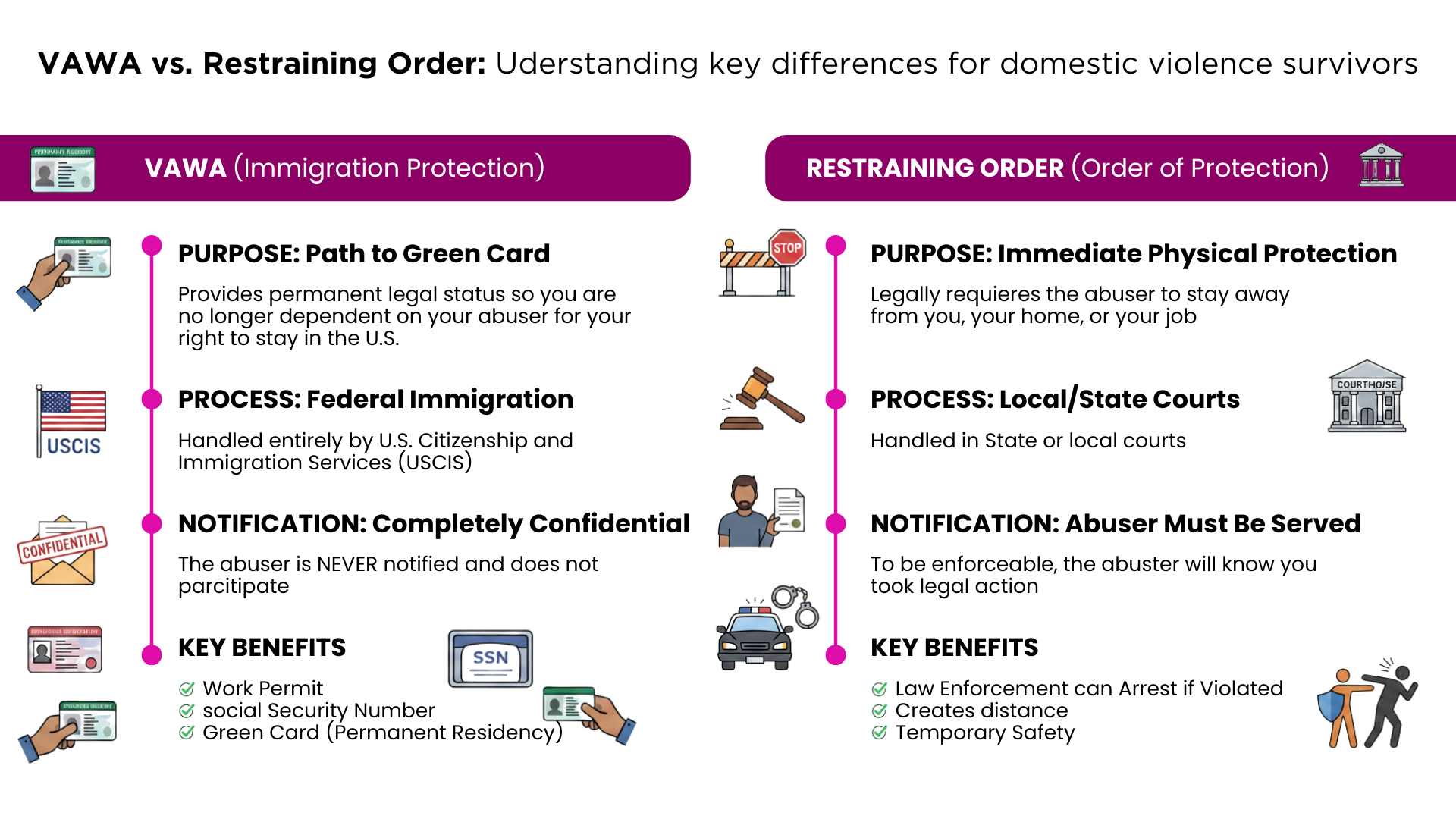
Think of a restraining order as a physical shield for your immediate safety, while VAWA is a legal shield for your long-term future in this country.
Restraining Orders (Orders of Protection):
Purpose: To provide immediate physical protection by legally requiring the abuser to stay away from you, your home, or your job.
Process: These are handled in local or state courts.
Notification: To be enforceable, the abuser usually must be “served” with papers, meaning they will know you have taken legal action.
Result: Provides law enforcement with the power to arrest the abuser if they break the rules of the order.
VAWA (Immigration Protection):
Purpose: To provide you with permanent legal status and a path to be Green Card holder so you are no longer dependent on your abuser for your right to stay in the U.S.
Process: This is a federal immigration process handled entirely by USCIS.
Notification: This is a completely confidential process. The abuser is never notified and does not participate in any way.
Result: Provides you with a work permit, a Social Security number, and eventually, permanent residency.
Do they work together?
Yes. You can pursue both at the same time. If you have a restraining order, it can actually serve as powerful evidence for your VAWA case to prove the “extreme cruelty” or “battery” you experienced. However, if you are afraid that filing a restraining order will provoke your abuser, you can still move forward with a VAWA petition in total secrecy.
Your safety plan is personal. Whether you need immediate physical distance through a court order or long-term peace of mind through immigration status, we are here to support your choice.
VAWA Common Questions
We know that when you are in a situation of domestic violence, your mind is constantly weighing the risks of every move you make. To help you feel more secure in your decision, we’ve gathered the most frequent questions survivors ask us at Elizabeth Rosario Law. Your safety is our benchmark for every answer.
Will My Spouse Find Out If I Apply?
The answer is a firm no. Under federal law (8 U.S.C. Section 1367), USCIS is strictly prohibited from notifying your spouse about your VAWA application. These non-disclosure requirements are so strict that any government employee who breaks them can face serious disciplinary action. At our firm, we take this a step further by acting as your legal representative, meaning all communication goes to us—never to your home.
1. What If My Abuser Has Government Connections?
This is a terrifying thought for many—especially if an abuser is in law enforcement, the military, or has high-ranking political friends. However, VAWA confidentiality protections are federal law. They supersede any personal relationships or professional positions. The specialized USCIS officers who handle VAWA cases are located in a secure, central location far away from local offices, specifically to prevent local "connections" from interfering with your case.
I’m already divorced, can I still apply?
Yes, you can. Many survivors believe that once the marriage ends, their chance for legal status ends too. This is not true. You can still file a VAWA self-petition if:
You file within two years of your divorce becoming final.
You can show that the abuse occurred during the marriage.
You can demonstrate that there was a connection between the abuse and the divorce. Ending a toxic marriage is a step toward safety; VAWA ensures it isn't a step toward losing your status.
My father abused me my whole life—can I apply?
Yes. While many people associate VAWA with spouses, the law also protects children (and even parents) of abusers. If you were abused by a parent who is a U.S. citizen or Green Card holder, you can file a self-petition. Generally, you must file before you turn 21, but if you can show the abuse caused a delay, you may be able to file up until the age of 25. No one should have to suffer in silence because of a family member's cruelty.
1. Can I Move During My VAWA Case?
Yes, and in fact, moving to a safer location is often a vital part of your safety plan. Your VAWA case travels with you. If you need to relocate to get away from your abuser, you can do so without losing your place in line. To keep your case on track while staying hidden, we will help you:
Update your address with USCIS: We use Form AR-11 to keep the government informed of where to send your documents.
Maintain Attorney Contact: You must notify us immediately of any move so your legal "shield" stays intact.
Safe Mail Handling: We recommend using our law office address as your "permanent" mailing address so that even if you move several times, your important documents stay in one secure place.
Absolute Secrecy: Your new residential address is flagged in the USCIS system as confidential, ensuring it is never shared with your abuser.
What About Digital Evidence and Online Privacy?
While the federal government builds a “legal wall” around your case files, we want to make sure your “digital wall” is just as strong. In many cases, an abuser may try to use technology to maintain control or monitor your movements. At Elizabeth Rosario Law, we guide you on how to turn your digital footprint from a vulnerability into a powerful tool for your case.
Protecting Yourself Online
While USCIS protects your case information, you should also take active steps to protect your daily privacy:
Review Social Media Settings: Set your profiles to the highest privacy levels. Be cautious about who can see your posts, as mutual friends may unintentionally share your information with your abuser.
Be Careful with Location Sharing: Many apps, including photos, maps, and social media, automatically tag your location. Check your phone settings to disable “Location Services” for any app that isn't essential.
Change Your Passwords: If your abuser has ever had access to your phone or computer, assume they know your passwords. Change them to something they couldn’t guess, and consider using a password manager that is locked with a fingerprint or face ID.
Document Online Harassment: If your abuser sends threatening emails, social media messages, or texts, do not delete them. These are vital pieces of digital evidence. Take screenshots and store them in a safe place, like a "hidden" folder or a secure cloud account that only you can access.
Getting Help and Support
If you’re considering a VAWA application, remember that you are part of a community that wants to see you safe and successful. You have an entire network of support waiting for you:
National Domestic Violence Hotline: Available 24/7 at 1-800-799-7233. They can provide immediate safety planning and emotional support.
Immigration Attorneys: Specialists like our team at Elizabeth Rosario Law who understand the unique intersection of domestic violence and immigration law.
Support Groups: Connecting with other survivors can help you realize that you aren't alone and that a life of freedom is possible.
The confidential process for domestic violence immigration relief exists specifically to protect survivors like you. You have the legal right to seek safety, work authorization, and a permanent home in the United States without the fear of your abuser finding out.
Ready for the next step?
Knowing whether your abuser will find out about your VAWA application is essential knowledge that protects your search for immigration status; that is why it’s important to remember: you don’t have to face this situation alone.
By familiarizing yourself with the strict confidentiality laws, gathering your evidence, and working with your (future) dedicated immigration legal team, you transform fear into solid confidence.
If you want to work in your VAWA application...
...and need immediate legal advice, at Elizabeth Rosario Law, we have a team ready to protect your civil liberties. Take the first step toward a new immigration status. Share this guide with your family and don’t wait any longer to ensure your legal rights.
Have you started gathering your documents yet? Contact us and schedule your free case evaluation today.
Disclaimer: This content is for general informational purposes only and does not constitute legal advice. Immigration laws change frequently and the information here may not reflect the most current legal developments. Consult an attorney for advice on your specific situation.
Elizabeth Rosario
Immigration Attorney with 14+ years of experience helping families navigate complex immigration matters.
Newsletter
Subscribe to our newsletter for important immigration law updates and resources for your case.
We respect your privacy. You can unsubscribe at any time.